
Easy Grader
Enter how many questions or points the test has and how many were wrong, right or earned. See the score as a percentage, a fraction and a grade on the scale you choose, with a chart of every possible number wrong that a teacher can print and mark a stack of papers from.
- No account needed
- Free, no limits
- Nothing is uploaded
How it works
- 01
Enter the test and the result
Type the number of questions or total points, then the number wrong, the number right or the points earned. Switch on half points for partial credit and add any extra credit.
- 02
Choose your grade scale
Pick letter grades A to F, letters with plus and minus, pass or fail with your own pass mark, percentage only, or type your own table of grades. The choice is remembered on this device.
- 03
Read the score, or use the chart
See the percentage, the fraction, the grade and how it was worked out. Below it, the target line and the full chart for every number wrong, ready to copy or print.
Test scores
A score is a fraction, the grade is a convention
A test score is the part of the test you got right, written as a percentage: the points earned divided by the total points, times 100. With 20 questions and 3 wrong, that is (20 − 3) ÷ 20 × 100 = 85 %, or 17/20. When every question is worth one point, the number of questions is the total; when questions carry different points, enter the total points and the points earned instead. Partial credit works the same way in half points, so 2½ wrong out of 25 is 22.5 ÷ 25 = 90 %. Extra credit is added to the points earned but not to the total, which is how a score can go above 100 %.
| Wrong | Score | Percent | Grade |
|---|---|---|---|
| 0 | 20/20 | 100 % | A |
| 1 | 19/20 | 95 % | A |
| 2 | 18/20 | 90 % | A |
| 3 | 17/20 | 85 % | B |
| 4 | 16/20 | 80 % | B |
| 5 | 15/20 | 75 % | C |
| 6 | 14/20 | 70 % | C |
| 7 | 13/20 | 65 % | D |
| 8 | 12/20 | 60 % | D |
| 9 | 11/20 | 55 % | F |
| 10 | 10/20 | 50 % | F |
Turning the percentage into a grade is a choice each school makes, and there is no single rule. In many US schools, letter grades start at 90 for an A, 80 for a B, 70 for a C and 60 for a D, with F below. Schools that use plus and minus usually split each ten into three: for example A from 93, A− from 90, B+ from 87, B from 83 and B− from 80, and the same pattern down to D− from 60. Some leave out D+ and D−, some add an A+ from 97, and some set the D at 65. Many other schools use pass or fail at a fixed mark, or their own number or word grades. That is why the scale here can be edited row by row: type each grade and the lowest percentage that earns it, in any order.
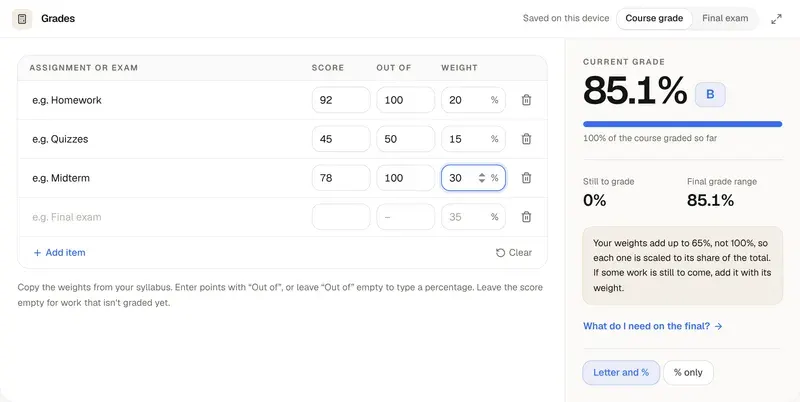
The most common mistake is rounding. 89.5 % is an A if the percentage is rounded to a whole number first and a B if it is not, so the tool lets you choose whole numbers or one decimal and always rounds halves up, the usual school convention. The grade is taken from the percentage as shown. The target line uses the same rules: it tells you the most you can get wrong and still reach a percentage or a grade. Check which way your teacher rounds before you rely on a score near a cut-off, and remember that a test grade is one part of a course grade. To combine tests, homework and a final exam, the grade calculator weights them for you.
The chart lists every possible number wrong from none to all of them, so a teacher can mark a pile of papers without working each one out. It covers tests of up to 200 questions, or 100 with half points, and can be copied as a table into a spreadsheet or printed on its own. The score is plain arithmetic and not an official result: your school's own grading policy decides your grade. Everything runs in your browser and nothing you enter is uploaded. PocketNote keeps a course's lectures, PDFs and notes in one place and turns them into flashcards and practice quizzes.
FAQ
Questions, answered
Keep reading
Go deeper into the science
Get more right on the next test
PocketNote keeps a course's lectures, PDFs and notes in one notebook and turns them into flashcards and practice quizzes.