
Chegg Study is a homework-help subscription built on two things: a library of fully explained, step-by-step solutions, and a network of experts who answer questions you submit. Its app listings describe more than 60 million solved homework questions across around 80 subjects, a scanner that lets you photograph a question and send it to an expert, and AI solutions backed by experts for faster help.
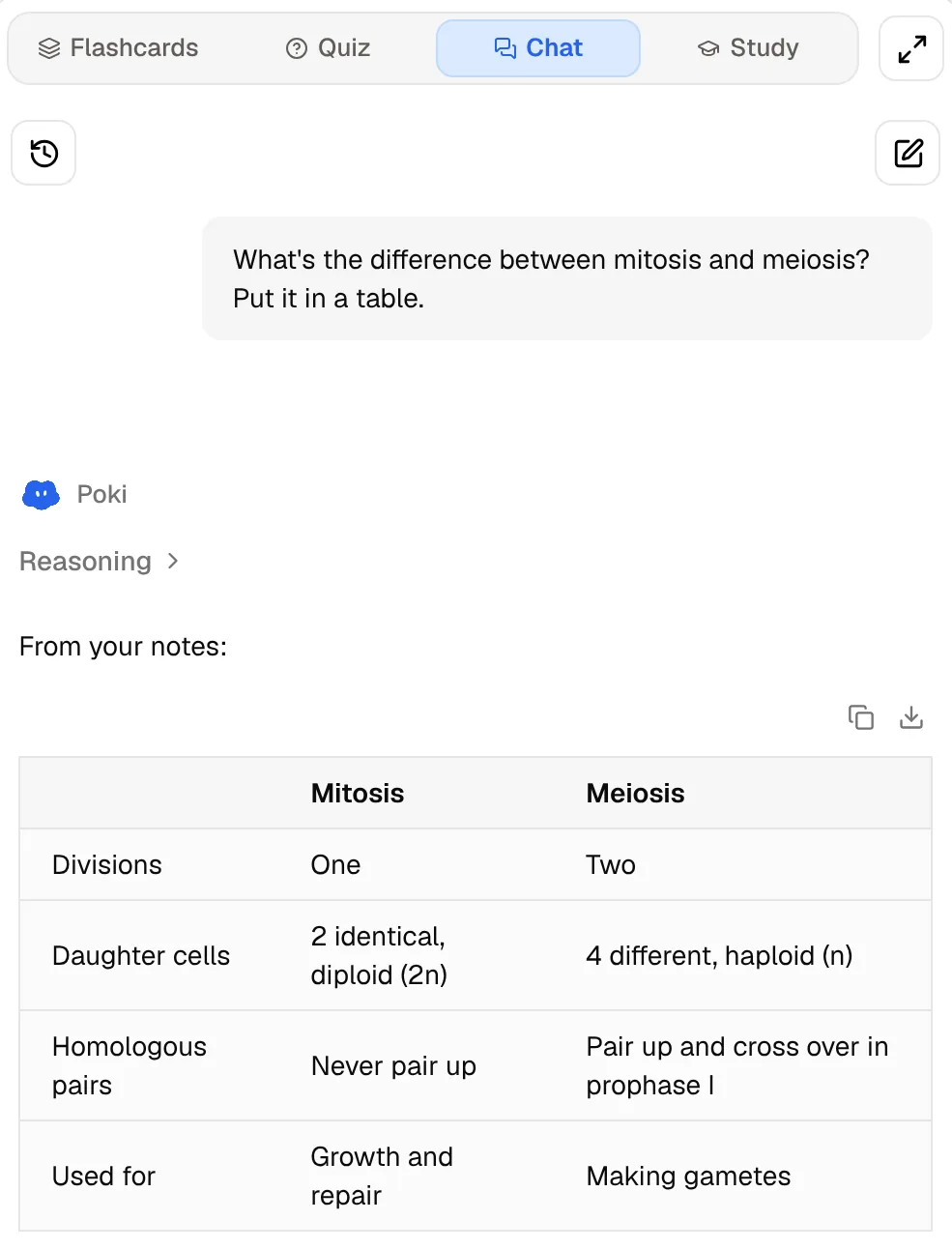
PocketNote does not solve homework. It is a study app: you bring your course material, and it turns it into flashcards with spaced repetition, quizzes that explain every option, and an oral exam where Prof. Poki keeps asking until you can explain the idea yourself. Its job starts where Chegg's ends, when you need to produce the method without a solution in front of you.
So this is less a contest than a question of which job you are doing tonight. This post explains both, says plainly where Chegg is the better tool, and shows how the two can fit into one semester. Chegg's details were checked against its app listings and announcements in November 2026.
At a glance
PocketNote vs Chegg
| Feature | PocketNote | Chegg |
|---|---|---|
| Core | Study tools from your own material | Solved-question library and expert Q&A |
| Step-by-step solutions | No solutions library | Yes, textbook and homework questions |
| Ask a human expert | AI only (Poki) | Yes, 24/7 |
| Scan a question | Not a photo solver | Question scanner |
| Flashcards | Spaced repetition from your material | Flashcards in the library |
| Explain it out loud | Oral exam with Prof. Poki | Not advertised |
| Lecture recording | Yes, with transcript and notes | Not advertised |
| PDF annotation and handwriting | Yes | Not advertised |
| Exam-date study plan | Yes, with reminders and mastery scores | Not advertised |
| Platforms | Web, iPhone, iPad | Web, iOS, Android |
| Price model | Free to start; Basic and Plus plans | Paid subscription, renews automatically |
Checked against PocketNote's website and Chegg's App Store and Google Play listings and announcements, November 2026. Plans and features change; confirm current details there.
What a Chegg Study subscription gives you
The library is the main draw. Chegg describes millions of fully explained, step-by-step solutions for subjects including math, English, physics, engineering and chemistry, plus flashcards, covering around 80 subjects and hundreds of courses. If your problem set comes from a widely used textbook, there is a good chance a worked solution exists.
When it does not, you can ask. The question scanner lets you photograph a homework question and submit it to Chegg's experts, who reply around the clock. Chegg says answers can arrive in as little as 30 minutes, and its fine print gives an average response time of 46 minutes, varying by subject.
Chegg has also added AI. Its listings describe AI solutions backed by experts. In April 2025 it announced Solution Scout, which compares answers from Chegg's archive with answers from several AI models and highlights where they agree and differ; it followed a Create feature for generating practice tests from your own class notes. Check which of these are included in your plan when you sign up.
Solution Scout also makes a useful point on its own: answers to the same problem can differ. Expert and AI solutions can both contain mistakes, so a worked solution is best treated as something to check against your lecture notes and your own reasoning rather than as the final word.
Why following a solution is not the same as solving
A step-by-step solution is clear because someone else made all the decisions: which principle applies, which equation to start from, which simplification to make. Reading it, every step looks obvious. That feeling is misleading, because the exam tests exactly those decisions, on a problem you have not seen, with nothing to read.
Take a physics student with a projectile problem. The solution splits the motion into horizontal and vertical parts, applies the right kinematic equation to each, and solves for time of flight. Reading it takes two minutes and every line makes sense. In the exam, the question involves a ball rolling off a table into a moving cart, and the student has to see on their own that it is the same idea. Recognizing that is the part a solution cannot practise for you.
Learning research is consistent on the broad principle: trying to retrieve or produce an answer yourself, and doing it repeatedly over time, builds knowledge that lasts better than reviewing finished answers. Worked examples are a good way to meet a method that is brand new; once you have seen it, a solution works best as a check after you have attempted the problem yourself.
Chegg can be used that way: attempt first, then compare. The risk is the order. When the solution is one tap away, it is easy to read it first, and then the attempt never happens.
Practising the method in PocketNote
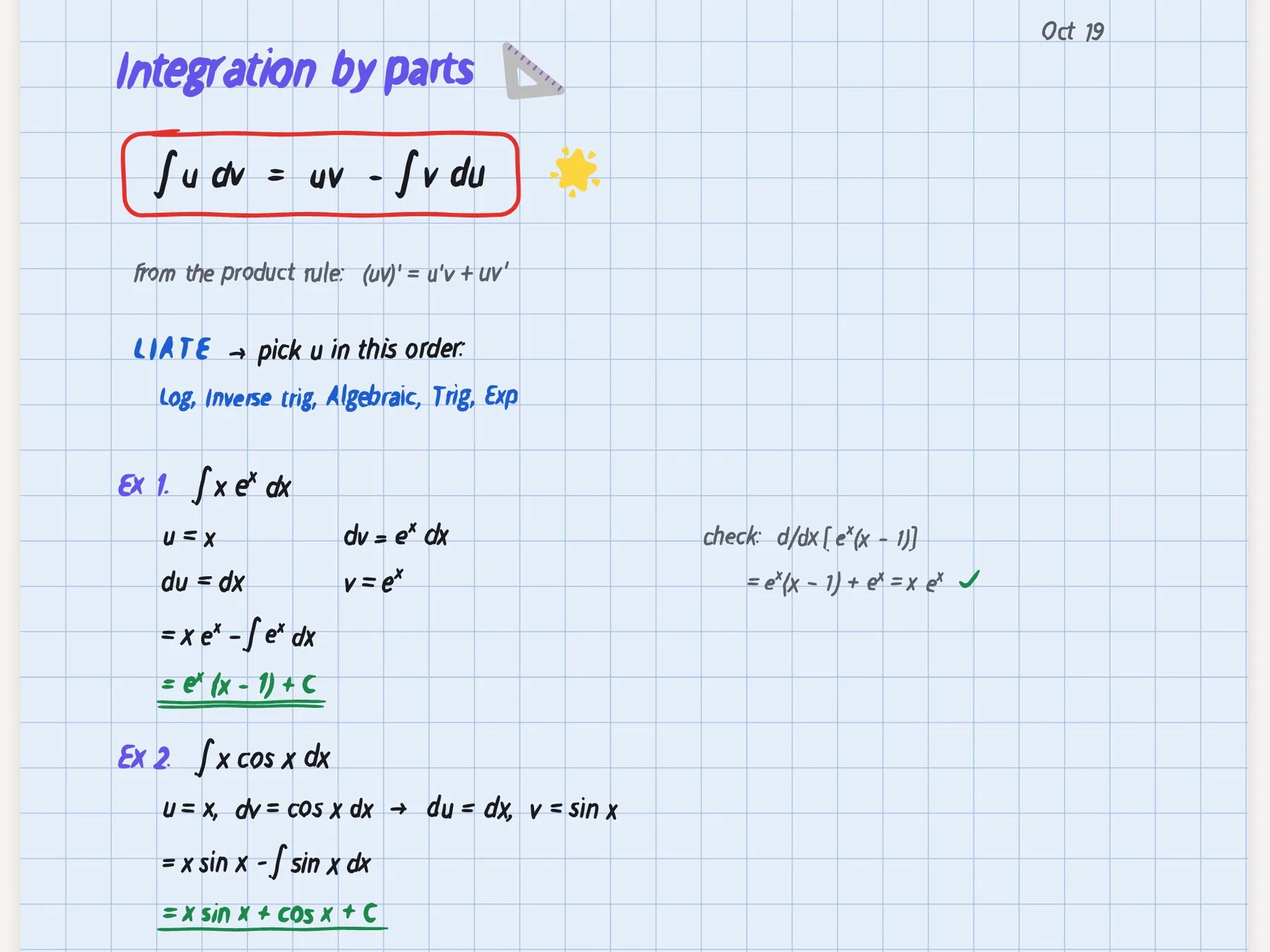
PocketNote builds practice from your own course: the lecture slides, the textbook chapters you were assigned (as PDF or Word files), your recorded lectures and your own notes. From those it generates quizzes in which every option is explained, the wrong ones included, so a mistake shows you which idea you confused with which.
Flashcards cover what must be memorized, such as definitions, formulas and conditions for a theorem. You rate each card Again, Hard, Good or Easy, and it comes back on a spaced-repetition schedule, just before you would forget it.
For method and reasoning, the oral exam does what a solution cannot. Prof. Poki asks you a question, out loud or in text, and when your answer is vague or incomplete it follows up. You cannot read your way through it; you have to explain.
If your lecturer publishes past papers or practice questions, import them as PDFs alongside the lecture slides. Quizzes and flashcards can then draw on the kinds of questions your course actually asks, and Poki can answer questions about a past-paper problem from your own notes, citing the slide or page it used.
Problem sets, PDFs and handwritten working
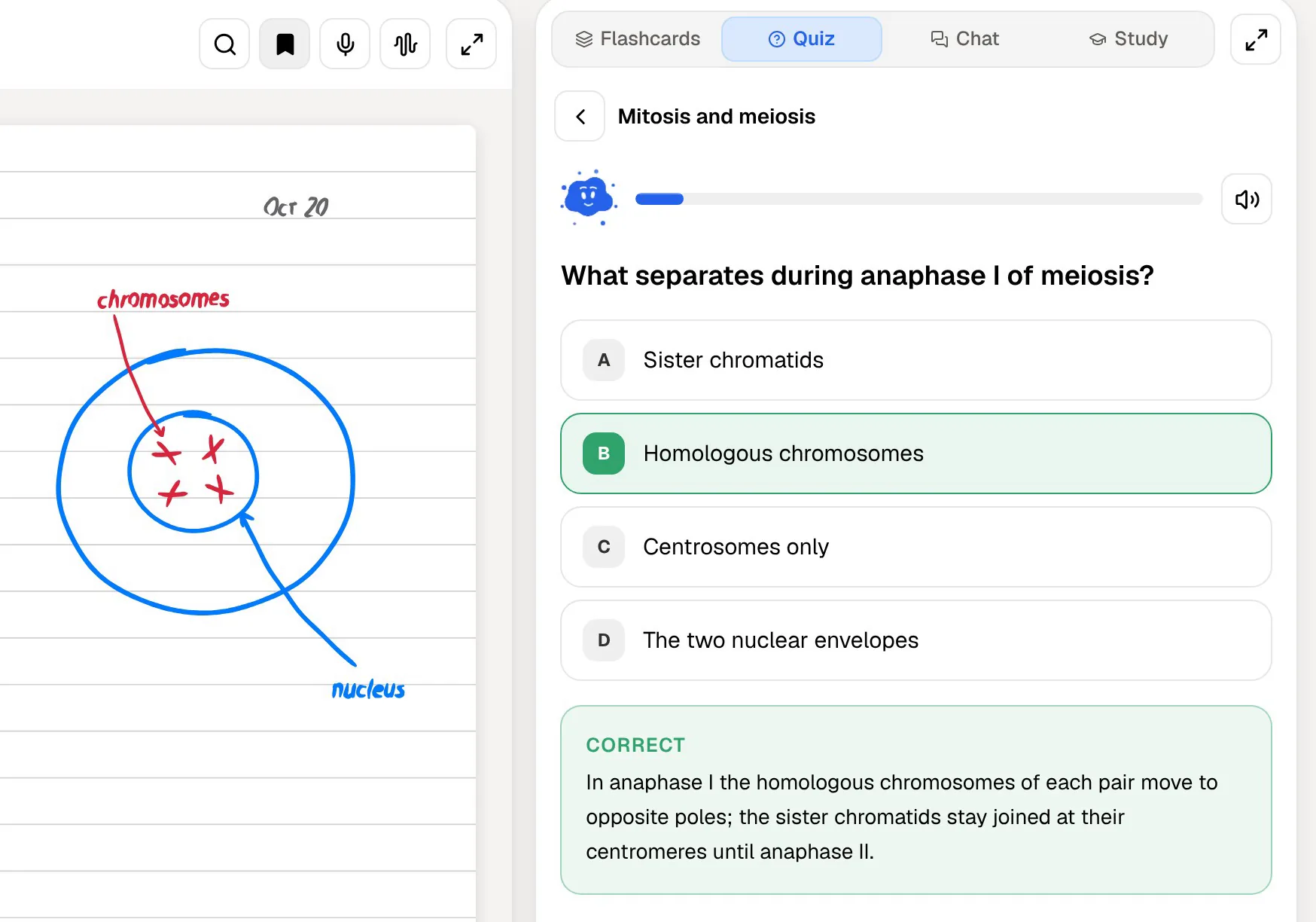
PocketNote is not a math photo solver, and it does not have a textbook-solutions library. What it gives a problem-heavy course is a place to work. You can import the problem sheet as a PDF and write on it directly: highlight the givens, circle the quantity you need, and sketch a diagram in the margin.
On an iPad with Apple Pencil, you can work a problem by hand on a grid page, use the lasso to select a line of working and ask Poki about it, or turn your handwriting into text. The "tape" tool hides an answer so you can retry the problem later without seeing your own solution. Typed notes support LaTeX for equations when you want a clean summary of methods.
Poki can also look at a PDF page as you see it, including your highlights and handwriting, and answer questions about that page from your course material, with citations. If you ask, it can highlight or circle passages on the PDF, and one tap undoes its marks. For a unit with many methods, a generated mind map or summary of the lecture notes can lay out which method belongs to which kind of problem, which is the decision a worked solution makes for you.
Rules on outside help
Course policies on homework services vary widely. Some instructors allow solution manuals for ungraded practice; others prohibit outside help on any graded assignment, and many forbid sharing exam or assignment questions. Those rules apply whichever service you use, and they increasingly cover AI tools too.
The practical step is to read the integrity section of each course syllabus and follow it for graded work. PocketNote is designed for studying your own material, which keeps it on the study side of most policies, but if a course limits AI use, that limit covers Poki as well. If you are unsure whether a particular use is allowed, ask your instructor or teaching assistant before the assignment is due, and keep a note of the answer.
Subscription and price
Chegg Study is a paid subscription that renews automatically until you turn renewal off. Prices vary by plan and by where you buy, so check Chegg's own site or app for current pricing before subscribing.
PocketNote is free to start. Its paid plans are Basic (live voice, premium AI models and connectors) and Plus (unlimited notebooks and apps, the longest podcasts and all models). See pocketnote.app for current prices.
If you are deciding between them on cost, think about timing. Homework help is most useful during weeks of heavy problem sets; a study app is most useful in the run-up to exams. Whatever you choose, match the subscription to the part of the term when you will actually use it.
Where Chegg is the better choice
Chegg does several things PocketNote does not attempt, and for these it is the right tool.
- You are stuck on a specific textbook problem. A step-by-step solution may already exist in Chegg's library.
- You want a person to answer. Chegg's experts respond around the clock; PocketNote's help is AI only.
- You want to check a final answer. Comparing your own attempt with a worked solution is a legitimate use when your course allows it.
- Your course is problem-set heavy in engineering, physics or accounting. Large solution coverage matters most there.
- You use Android. Chegg has an Android app; PocketNote runs on the web, iPhone and iPad.
A week with both
On Monday a problem set is due. You attempt each problem first, use Chegg (within your course's rules) to check the ones you could not finish, and note the concept behind each one you got wrong.
On Tuesday you add those concepts to PocketNote: a flashcard for the formula, and the lecture slides that explain it, so the next quiz includes them. By Friday you are answering explained quiz questions on that topic, and on the weekend you ask Poki out loud to quiz you on it while you walk, with live voice on paid plans. The solution got you through Monday; the practice is what you will carry into the exam.
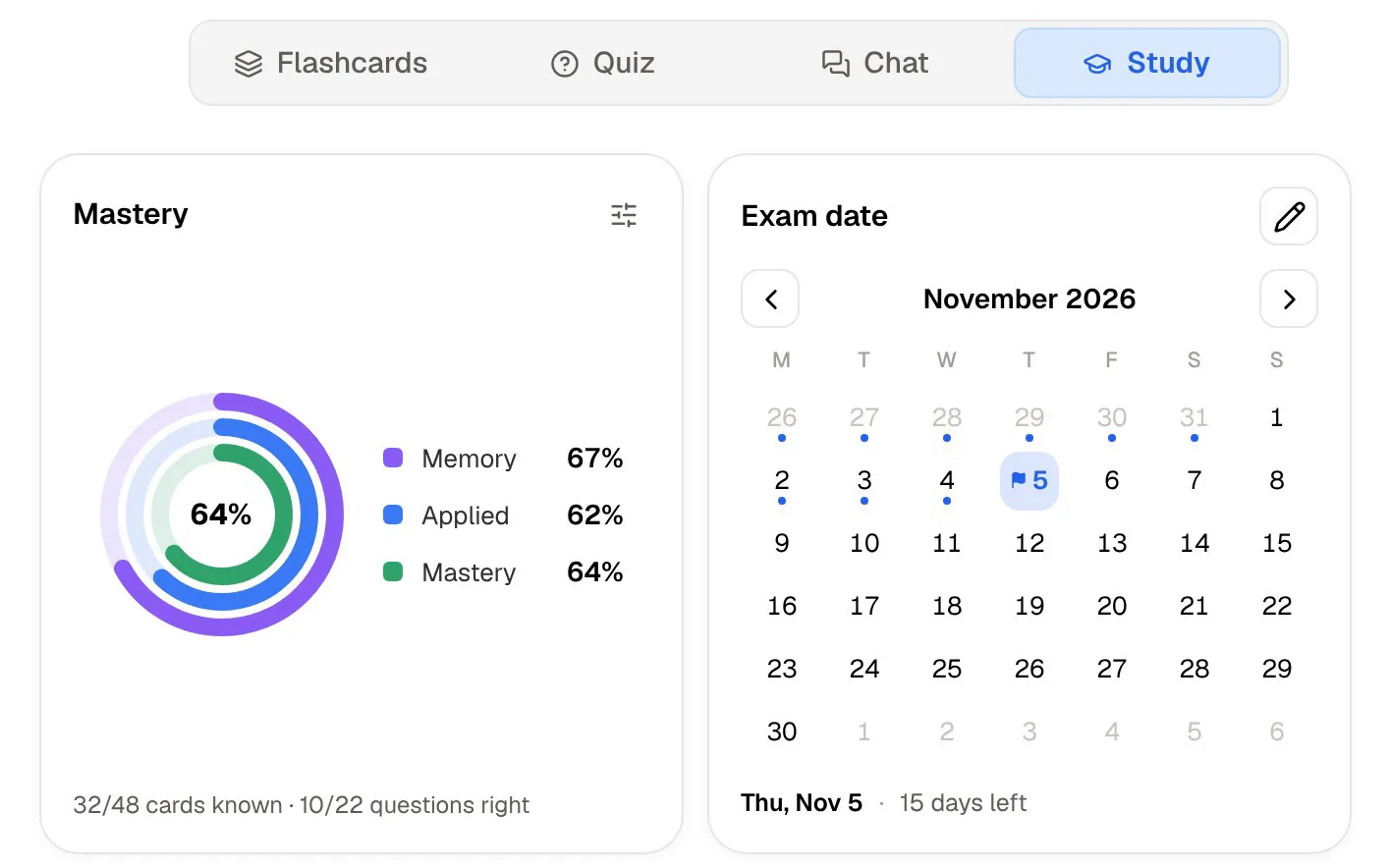
As the exam approaches, the study plan takes over. You set the date, and PocketNote spreads the remaining topics across the days you have left, sends reminders, and tracks memory, applied and mastery scores, so you can see which topics from the problem sets are still weak and give them more of your final two weeks.
The verdict
Which one should you pick?
Pick PocketNote if…
- You need to be able to produce the method yourself in an exam, not just follow it.
- You want explained quizzes, spaced-repetition flashcards and an oral exam built from your own course.
- You want to annotate problem sheets and work by hand on an iPad, with an assistant that can read the page.
- You want an exam-date plan that tells you what to review each day.
Pick Chegg if…
- You need a worked, step-by-step solution to a specific textbook or homework problem.
- You want a human expert to answer a question, at any hour.
- Your course is problem-set heavy and solution coverage matters most, or you use Android.
Try it yourself
See it with your own notes
PocketNote is an AI study app for the web, iPhone and iPad. It turns your slides, readings, recordings and notes into quizzes that explain every answer, flashcards with spaced repetition, oral exams with Prof. Poki, audio reviews and a study plan built around your exam date. It is not a homework solver; it is where you practise until you no longer need one.
If Chegg is already part of your routine, try PocketNote on one topic you keep getting stuck on and see whether practice changes how the next problem set feels. It is free to start.
Frequently asked questions
Sources
Keep reading