
Gauth started life as Gauthmath, a math solver: photograph a problem and get the answer with steps. In 2024 it renamed itself Gauth to cover more subjects, and its app now calls itself an AI study companion. You can still snap a homework problem and get a step-by-step solution, and you can also talk a problem through with an AI Live Tutor on a whiteboard, ask 24/7 experts, and turn notes or lecture links into quizzes and flashcards.
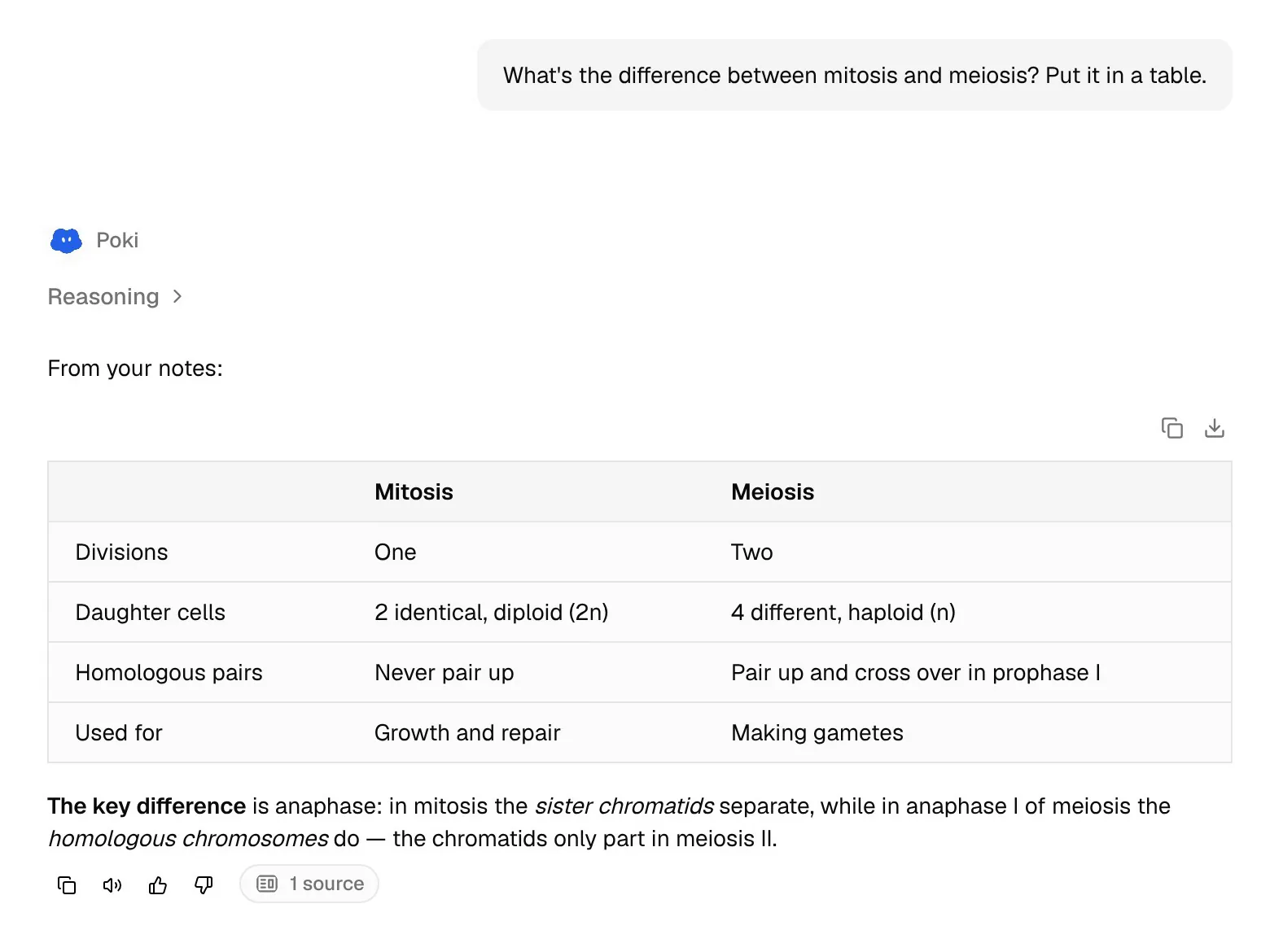
PocketNote is not a homework solver and not a math photo solver. It is a study app: you bring your own course material, and it turns it into flashcards on a spaced-repetition schedule, quizzes that explain every option, oral exams and a study plan for the exam date. Its assistant, Poki, answers from your material with citations rather than solving whatever you photograph.
So the two overlap less than their feature lists suggest. This post explains where each one fits, where Gauth is clearly the better tool, and how a student in a math or science course might use both. Gauth's details were checked against its website and app listings in November 2026.
At a glance
PocketNote vs Gauth
| Feature | PocketNote | Gauth |
|---|---|---|
| Starting point | Your course material | A photo or typed question |
| Photo homework solving | Not a photo solver | Yes, step by step |
| Subjects | Any subject in your material | Math, physics, chemistry, biology and more |
| Voice tutoring | Live voice with Poki (paid plans) | AI Live Tutor with voice and whiteboard |
| Human experts | AI only (Poki) | Experts available 24/7 |
| Notes into quizzes and flashcards | Yes, from files, audio, links and notes | Yes, Smart Study Converter |
| Spaced repetition | Yes, rate Again/Hard/Good/Easy | Not advertised |
| Handwritten math | Write on iPad, lasso it, ask Poki | Photograph it to solve |
| Answers drawn from | Your own files, with citations | Gauth's AI models and experts |
| Exam-date study plan | Yes, with reminders and mastery scores | Not advertised |
| Platforms | Web, iPhone, iPad | Web, iOS, Android |
| Free plan | Free to start | Limited answers; 3-day Plus trial |
Checked against each product's own website and Gauth's App Store and Google Play listings, November 2026. Plans and features change; confirm current details there.
From Gauthmath to Gauth
Gauth's own history page says it began in 2019 with an expert frustrated at watching students struggle with complex problems, and a model that matched students with experts and solved problems one step at a time. The name honors the mathematician Carl Friedrich Gauss. In 2024 Gauthmath became Gauth, so that it could support more subjects with more advanced AI.
The app today, published by Gauthtech, describes step-by-step learning guidance, an AI Live Tutor you speak to while it explains on a virtual whiteboard, a DeepThinking mode for harder questions, 24/7 experts in math, science and more, and a Smart Study Converter that turns notes, audio or lecture links into quizzes and flashcards. A study toolbox adds a writing assistant for grammar and structure, a text simplifier, a study timer and a calculator.
On the web, Gauth also offers Gauth Academy, AI-generated courses with visual lessons, 3D models and simulations, and Atlas, a tool for exploring a topic and tracing discoveries back to their sources. Math remains its deepest area: its listings break math support down from word problems and algebra through calculus, statistics, matrices and proofs.
What Gauth does well
Speed is the obvious strength. Point the camera at a problem, and Gauth crops it, recognizes it and returns a formatted solution with explanations. For checking a homework answer at night, that is hard to beat, and its coverage of math topics is broad.
The AI Live Tutor is the more interesting part for learning. Instead of a static solution, you ask by voice and watch the explanation build on a whiteboard, and you can ask again when a step is unclear. If a written solution leaves you stuck, a spoken, drawn explanation is a different way in.
Gauth also covers the moments when AI is not enough, with human experts available around the clock, and it has added genuine study features: generated quizzes and flashcards from your notes, and visual courses for topics you want to explore beyond the homework. When you import study materials, Gauth says its recognition tools organize them with clear formatting and structured explanations.
Solving tonight's problem and the next one
A solver answers the problem you give it. An exam gives you a problem you have not seen, worded differently, and expects you to choose the method yourself. Those are related skills, but only the second is graded, and it improves mainly through practice: attempting problems, recalling formulas and methods from memory, and spacing that practice out over the weeks before the exam.
Chemistry shows the gap well. A solver can balance an equation and work through a stoichiometry problem step by step. In the exam, the question describes a lab procedure in a paragraph, and the hard part is recognizing which quantity is limiting and which relationship to use. That recognition comes from having practised many problems and recalled the methods, not from having read many solutions.
Gauth can support that practice if you use it in that order: attempt first, then check, then ask the tutor about the step you got wrong. The convenience works against it, because a solution one tap away tempts you to skip the attempt. Rules matter as well. Gauth publishes an Honor Code, and your course decides what help is allowed on graded work, including AI tools, so check the syllabus.
PocketNote is designed for the practice half. It does not hand you solutions to new problems; it helps you remember and explain the methods your course taught, so that you can produce solutions yourself.
Math in PocketNote, honestly
To be plain: PocketNote cannot photograph a math problem and solve it. If that is what you need, use Gauth or a similar solver. What PocketNote offers a math or science course is a place to work and a way to practise.
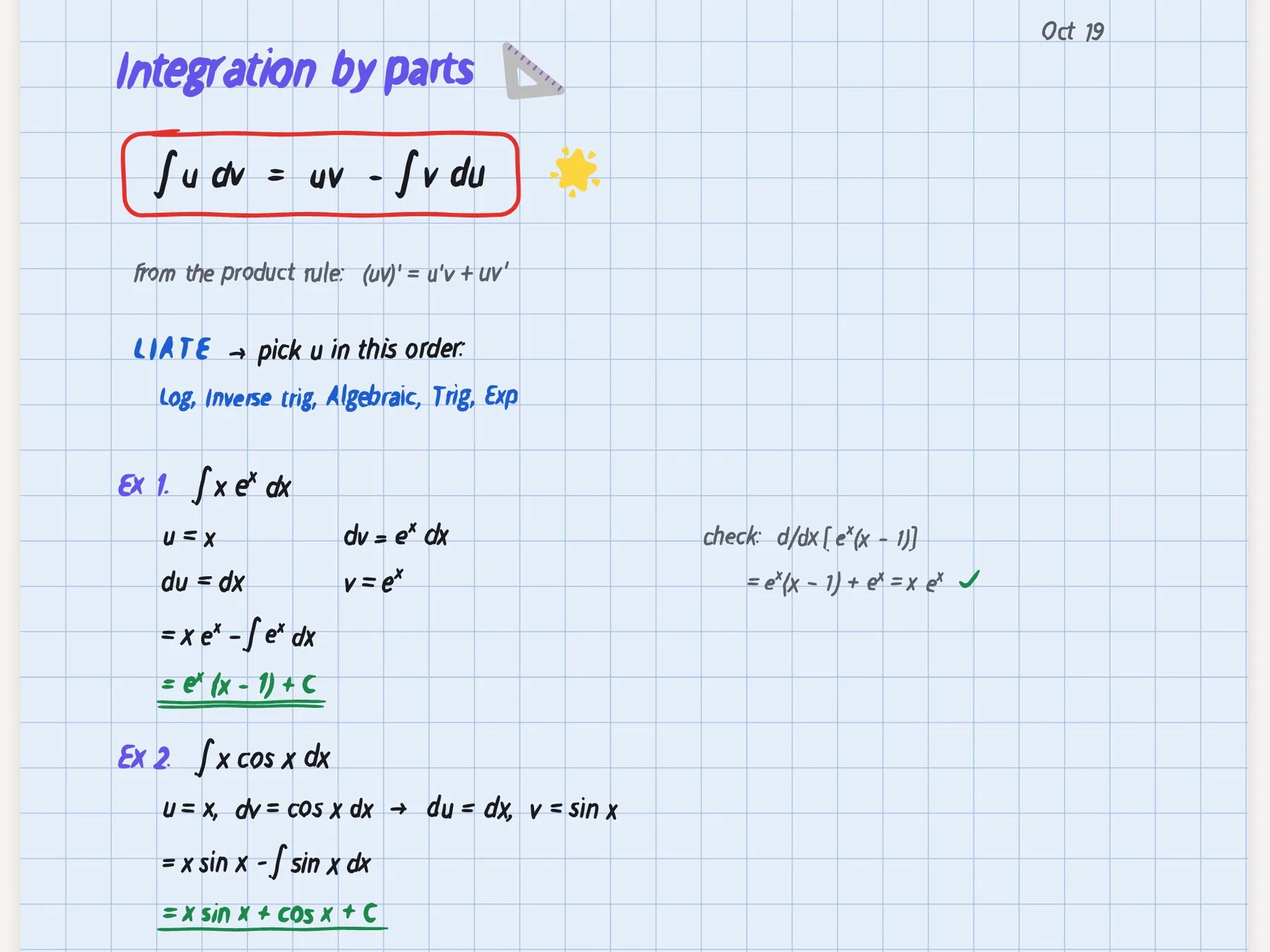
Typed notes support LaTeX, so you can keep a clean sheet of formulas and worked methods. On an iPad with Apple Pencil, you can work problems by hand on a grid page, select a line of working with the lasso and ask Poki about it, or convert the handwriting to text. The "tape" tool hides your worked answer so you can attempt the same problem again a week later without seeing your own solution.
Lecture slides and problem sheets come in as PDFs, and you can write on them directly. Poki can look at a PDF page as you see it, including your handwriting, and answer questions about it from your course material, citing the page it used. Flashcards then cover the formulas and conditions you must recall without a formula sheet.
Talking it through: whiteboard tutor or live Poki
Both apps let you study by speaking, but they point the conversation in opposite directions. Gauth's AI Live Tutor explains to you: you ask, and it walks through the problem on a whiteboard. That is the right shape when you do not yet understand something.
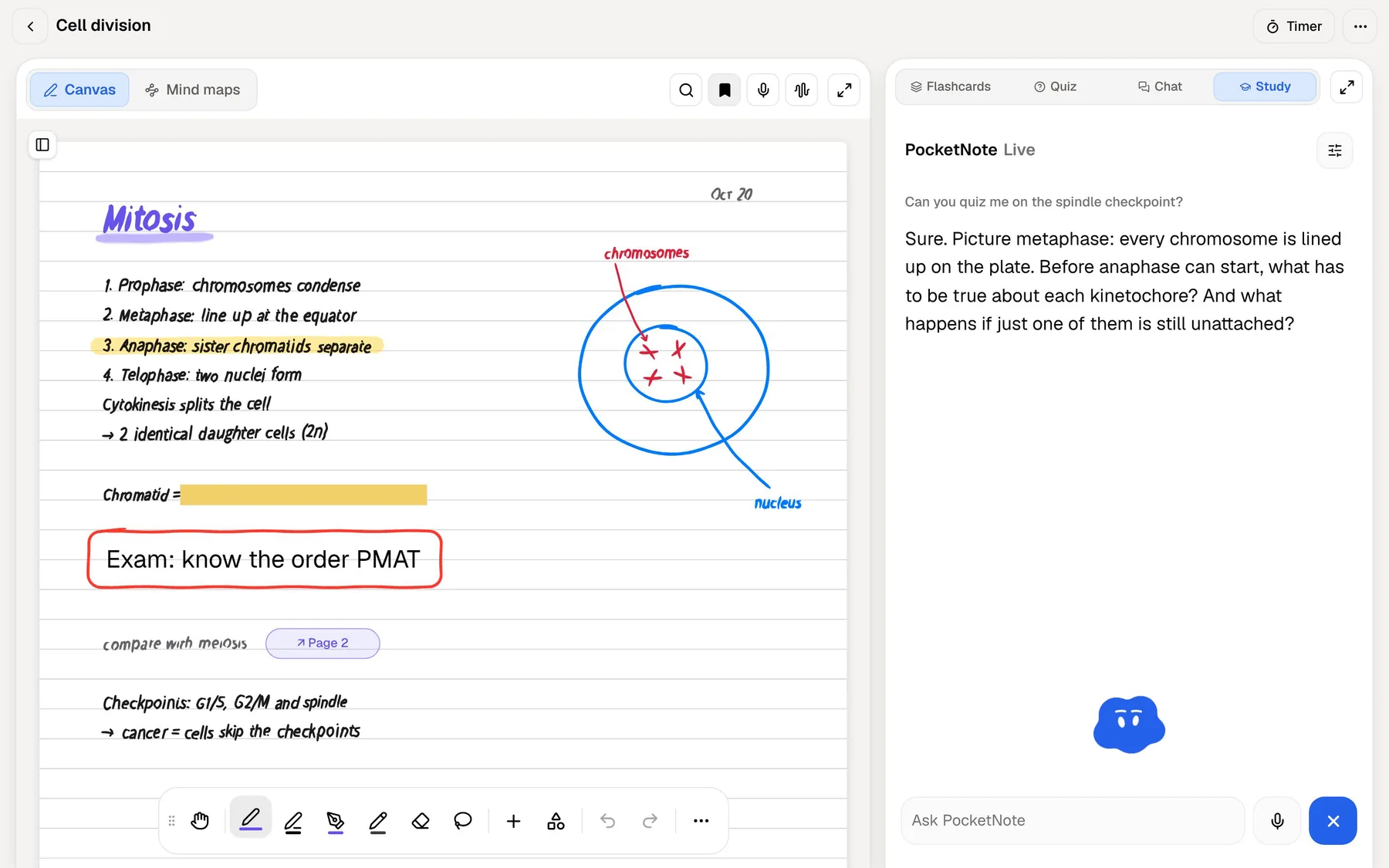
PocketNote's spoken tools mostly ask you. In the oral exam, Prof. Poki asks a question about your material, out loud or in text, and follows up until your explanation holds together. With live voice on paid plans, you can ask Poki to quiz you on a topic and answer by speaking. That is the right shape once you have learned something and need to check that you can produce it without help.
Turning notes into practice
This is where the two apps genuinely overlap. Gauth's Smart Study Converter turns notes, audio or lecture links into quizzes and flashcards. PocketNote generates flashcards, quizzes, mind maps, summaries, slide decks and audio reviews from your files, recordings, YouTube and web links, and your own handwritten or typed notes.
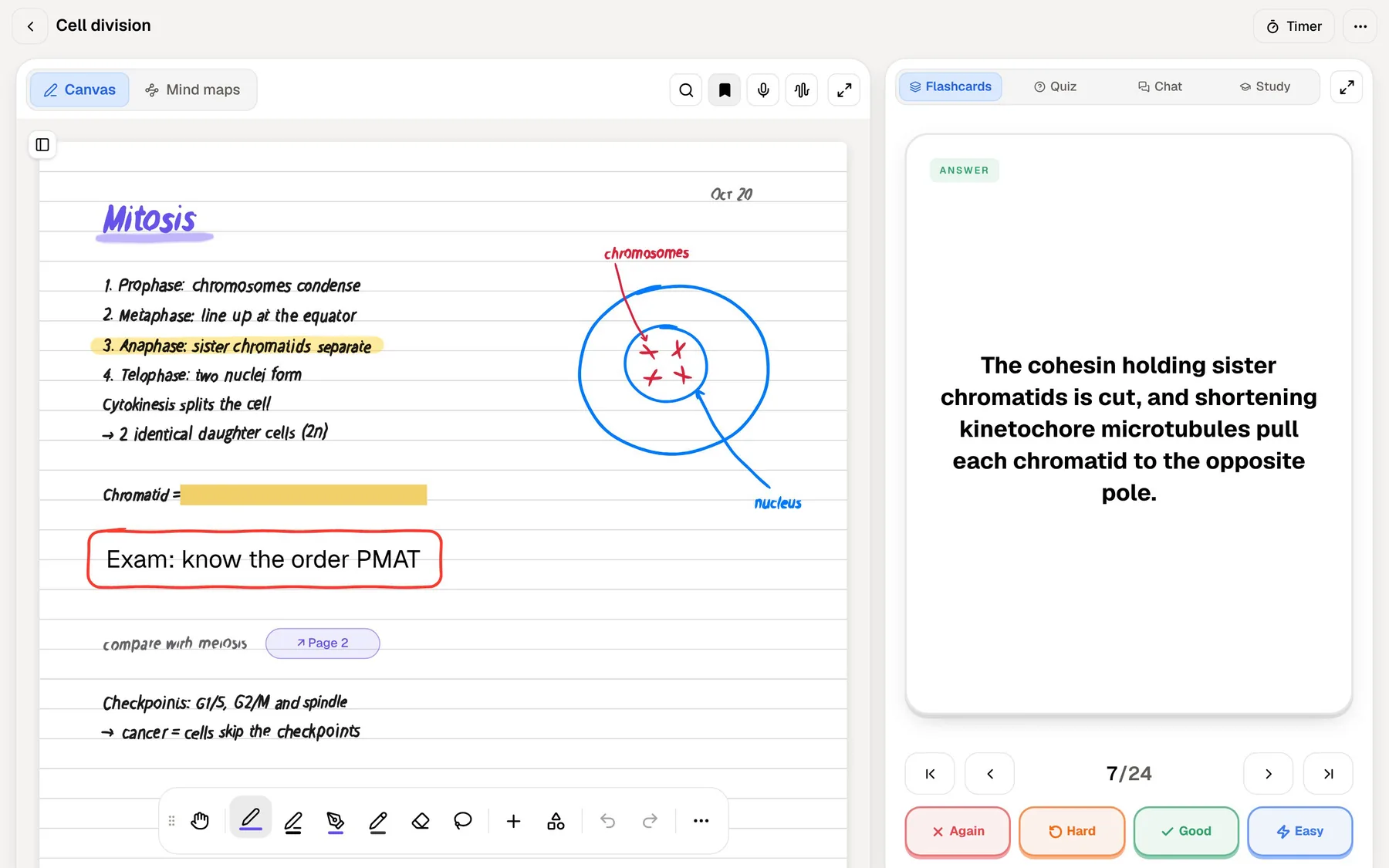
The difference is what happens after the cards are made. PocketNote schedules them: you rate each card Again, Hard, Good or Easy, and it returns just before you would forget it. Quizzes explain every option, right and wrong. A study plan then takes your exam date, spreads the material across the days you have left, sends reminders, and tracks memory, applied and mastery scores. Gauth does not advertise that kind of review scheduling.
The source matters too. Practice built from your own lecturer's slides and problem sheets uses the notation, methods and emphasis your exam will use. In PocketNote, everything for a course sits in one folder (the PDFs, recordings, links and notes), and every flashcard, quiz and plan draws on that same set, so practice stays aligned with the syllabus rather than a general version of the topic.
Plans and price
Gauth has a free plan with limited answers, limited AI queries and standard access to its AI courses. Gauth Plus offers unlimited answers and AI queries, premium course access, more Atlas credits, a large library of tutorial videos and practice questions, and priority expert help, with a 3-day free trial. Its app listing describes monthly, quarterly and annual subscriptions, with prices that vary by region, so check in the app.
PocketNote is free to start. Its paid plans are Basic (live voice, premium AI models and connectors) and Plus (unlimited notebooks and apps, the longest podcasts and all models). See pocketnote.app for current prices.
The two subscriptions pay off at different times. A solver earns its keep in weeks with heavy problem sets; a study app earns its keep in the weeks before exams. Use the free tiers of both for a couple of weeks and notice which one you actually open when you sit down to study.
Where Gauth is the better choice
Gauth is the right tool for several jobs PocketNote does not do.
- You need to check a homework answer from a photo. Gauth solves it with steps in seconds; PocketNote is not a photo solver.
- You do not understand a method yet. The AI Live Tutor explains by voice on a whiteboard, which suits learning something new.
- You want a human expert. Gauth has experts around the clock; PocketNote's help is AI only.
- You want to explore a topic visually. Gauth Academy's 3D lessons and simulations go beyond your course material.
- You use Android. Gauth has an Android app; PocketNote runs on the web, iPhone and iPad.
The verdict
Which one should you pick?
Pick PocketNote if…
- You need to remember and produce methods yourself in an exam, not just check answers.
- You want spaced-repetition flashcards, explained quizzes and an oral exam from your own course.
- You work problems by hand on an iPad and want to ask questions about your own working.
- You want a study plan that counts down to your exam date.
Pick Gauth if…
- You want fast, step-by-step solutions from a photo of a problem.
- You want an AI tutor that explains on a whiteboard, or a human expert, when you are stuck.
- You want visual courses on topics beyond your syllabus, or you use Android.
Try it yourself
See it with your own notes
PocketNote is an AI study app for the web, iPhone and iPad. It turns your slides, problem sheets, recordings and notes into flashcards with spaced repetition, quizzes that explain every answer, oral exams with Prof. Poki, audio reviews and a study plan built around your exam date. Typed notes support LaTeX, and on an iPad you can work by hand and ask Poki about your own working.
It is not a solver, so it pairs naturally with one: check tonight's answers wherever your course allows, and use PocketNote to make the methods stick. It is free to start.
Frequently asked questions
Sources
Keep reading