
PAU Grade Calculator
Enter your nota media de Bachillerato and your PAU marks. The calculator works out the fase de acceso, the nota de acceso out of 10 and the nota de admisión out of 14 with the two best weighted subjects for your degree, and shows every step. Or enter a nota de corte to see the mark you need in every exam.
- No account needed
- Free, no limits
- Nothing is uploaded
How it works
- 01
Enter Bachillerato and the fase de acceso
Type your nota media de Bachillerato without Religión and the mark of each exam of the fase de acceso: four exams, or five in regions with a co-official language.
- 02
Add the subjects that weight
Add your fase de admisión subjects and, for each one and for your modality subject, the parameter (0.1 or 0.2) your university gives it for the degree you want.
- 03
Read the result and the working
See the nota de admisión, the nota de acceso and the fase de acceso, which subjects count and why, the distance to a nota de corte, and each step with its rounding.
How the PAU marks are calculated
60 % Bachillerato, 40 % PAU, then the ponderaciones
Since the 2025 exams, the Prueba de Acceso a la Universidad is regulated by Real Decreto 534/2024. Its fase de acceso has four exams, or five in regions with a co-official language: Lengua Castellana y Literatura II (and Lengua Cooficial y Literatura II), Historia de España or Historia de la Filosofía, Lengua Extranjera II, and the compulsory subject of your Bachillerato modality, such as Matemáticas II. Each exam is marked from 0 to 10 with two decimals. The fase de acceso mark is their arithmetic mean, rounded to the nearest thousandth with halves up, and it must be at least 4 to count (art. 14). The nota de acceso is then 0.6 × nota media de Bachillerato + 0.4 × fase de acceso, again to three decimals, with the Bachillerato average taken without Religión (art. 15). With 5 or more you meet the access requirement, and that mark has no expiry date.
The nota de admisión is what universities rank applicants by, and it can reach 14. The Royal Decree adds to the nota de acceso the weighted marks of the subjects each university chooses, taking the combination most favourable to you (art. 22). The regional admission agreements fix the details: those of Madrid's public universities and of Andalucía's distrito único add the two best weighted marks and accept only subjects marked 5 or more, and in the tables of Madrid's universities the parameters are 0.1 or 0.2. So nota de admisión = nota de acceso + a × M1 + b × M2. The subjects can be up to three more Bachillerato subjects and a second foreign language sat in the fase de admisión, plus the modality subject of the fase de acceso. Those marks are valid for the next academic year and the two after it (art. 22.5).
| Step | Calculation | Result |
|---|---|---|
| Fase de acceso | (4.20 + 3.80 + 6.00 + 5.50) ÷ 4 | 4.875 |
| Nota de acceso (Bachillerato 5.60) | 0.6 × 5.60 + 0.4 × 4.875 | 5.310 |
| Nota de acceso (Bachillerato 5.00) | 0.6 × 5.00 + 0.4 × 4.875 | 4.950: not passed |
| Weighted subject | 5.00 × 0.2 | 1.000 |
| Weighted subject | 6.50 × 0.1 | 0.650 |
The most common mistakes are about the weights. A subject does not always count 0.2: each university publishes its own tabla de ponderaciones every year, and the same subject can be 0.2 for one degree, 0.1 for another and not weighted at all for a third. Only two subjects are added, even if you sit four; the calculator picks the two highest products, which are not always your two highest marks, since 9 × 0.1 adds less than 6 × 0.2. A subject under 5 adds nothing. Two more traps: a single exam under 4 does not fail the fase de acceso, because only the mean must reach 4, and the nota media de Bachillerato for access leaves Religión out.
This calculator applies the formulas; it does not know your university's table or this year's notas de corte, so you choose each parameter yourself. Regions add their own conditions. In Madrid, for example, Historia de España or Historia de la Filosofía can only be weighted if you pass it in the fase de admisión and did not sit it in the fase de acceso, and a second foreign language must differ from the one in the fase de acceso. Students with a Técnico Superior de Formación Profesional use the average of their ciclo as their access mark (art. 23.2) and are not covered here. The mark-for-a-nota-de-corte mode assumes the same mark in every exam. Your official marks and nota de admisión come from your region's PAU office and your university.
FAQ
Questions, answered
More free tools
Planning & grades
Grade Calculator
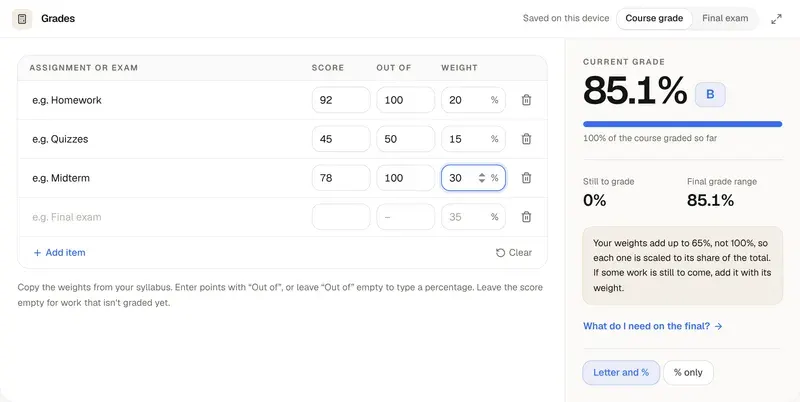
Your weighted grade, and what you need on the final.
Planning & grades
Study Schedule Maker
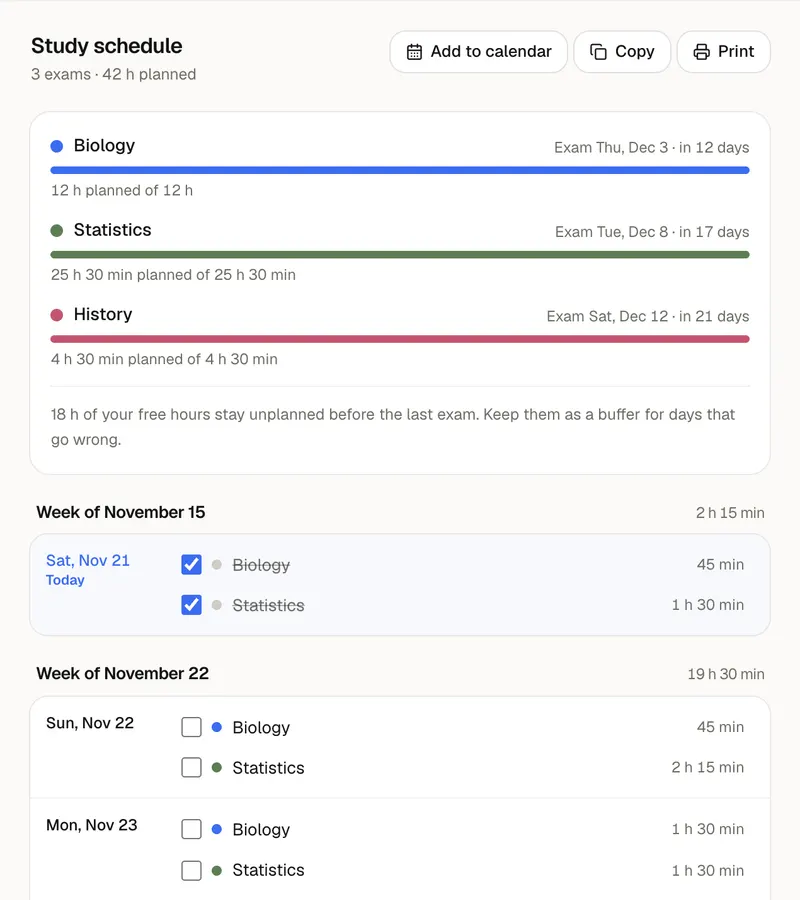
Your exams and free hours in, a day-by-day study plan out.
AI study tools
AI Quiz Generator
Practice questions from your own material, with answers explained.

Planning & grades
GPA Calculator
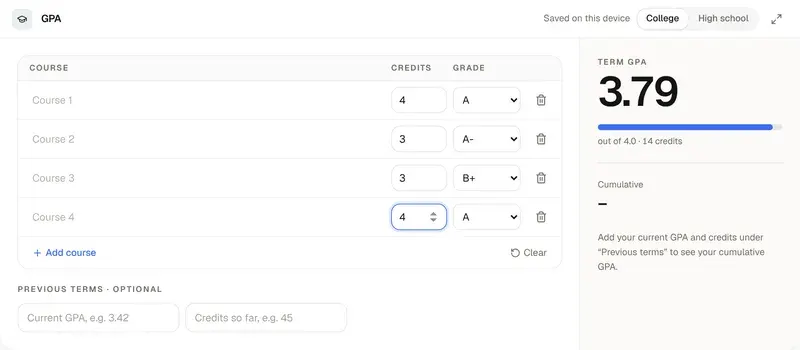
College or high school GPA, weighted or unweighted.
Keep reading
Go deeper into the science
Reach your nota de corte with steady review
PocketNote turns your notes into flashcards and quizzes for each PAU exam and plans your study until the exams.