
Case Converter
Type or paste text and change its case with one click: sentence case, lower case, upper case, capitalized, title case or alternating, plus camelCase, snake_case and other formats for code. Undo the last change, copy the result or download it.
- No account needed
- Free, no limits
- Nothing is uploaded
How it works
- 01
Paste or type your text
Put your text in the box. The character and word count are shown as you go, and nothing is uploaded.
- 02
Click a case
Choose Sentence case, lower case, UPPER CASE, Capitalized Case, Title Case or aLtErNaTiNg cAsE. For code there are camelCase, PascalCase, snake_case, kebab-case and CONSTANT_CASE.
- 03
Check, then copy
Reread names and acronyms, undo the last conversion if it isn't what you wanted, then copy the result or download it as a .txt file.
Capitalization
Title case has rules, and they differ
Each button does one job. Sentence case capitalizes the first word of every sentence and lowercases the rest, which is the quickest fix for a paragraph typed with Caps Lock on. lower case and UPPER CASE change every letter. Capitalized Case gives every word a capital. Title Case capitalizes the main words and keeps small words such as “a”, “of” and “the” in lowercase unless they come first or last. aLtErNaTiNg cAsE switches between lower and upper letter by letter. If a result isn't what you expected, undo the last conversion and try another button; your original text comes back.
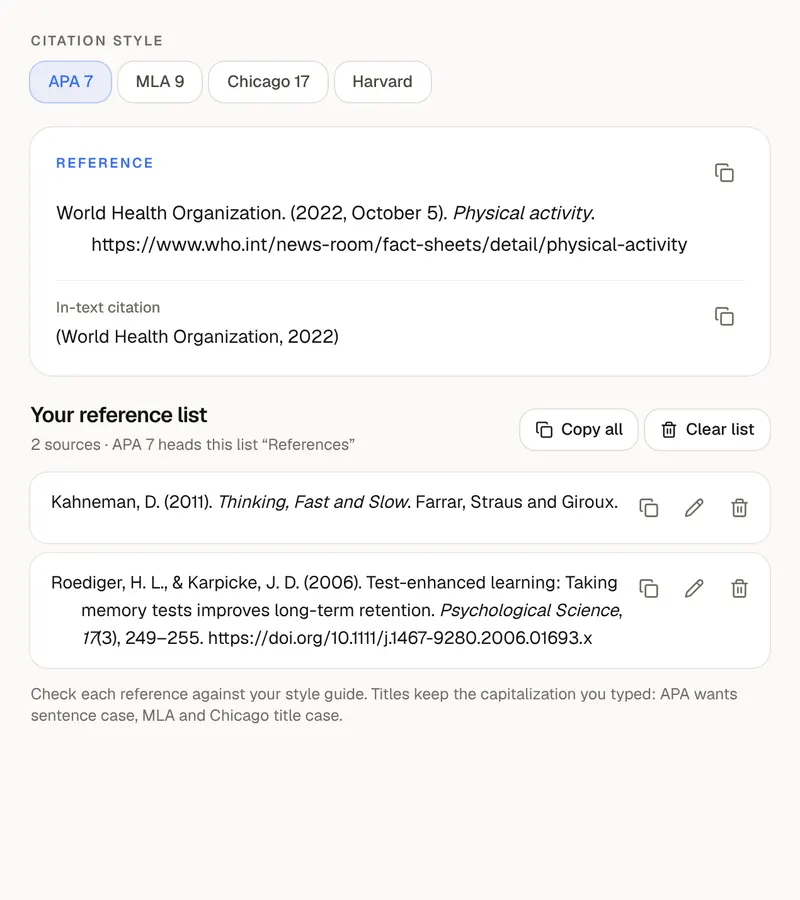
Title Case here follows the usual English small-word rules, but style guides don't fully agree on them. APA capitalizes every word of four letters or more, so “With” and “From” get capitals, while Chicago and MLA keep prepositions in lowercase whatever their length. Check a heading against the guide your course uses and change the one or two words that differ. Reference lists are a separate case: APA wants article and book titles in sentence case, MLA and Chicago in title case. The citation generator keeps titles exactly as you type them, so convert a title here first and paste it in.
A converter can't know what a word means. Sentence case lowercases “paris” and “nasa” along with everything else, so reread the result and put the capitals back on names, places and acronyms. Upper and lower case follow the language of the page: in Turkish the dotted İ and dotless ı are handled correctly, and in German ß becomes SS in upper case. The code formats join the words of a phrase the way programmers name things: “study notes file” becomes studyNotesFile in camelCase, StudyNotesFile in PascalCase, study_notes_file in snake_case, study-notes-file in kebab-case and STUDY_NOTES_FILE in CONSTANT_CASE.
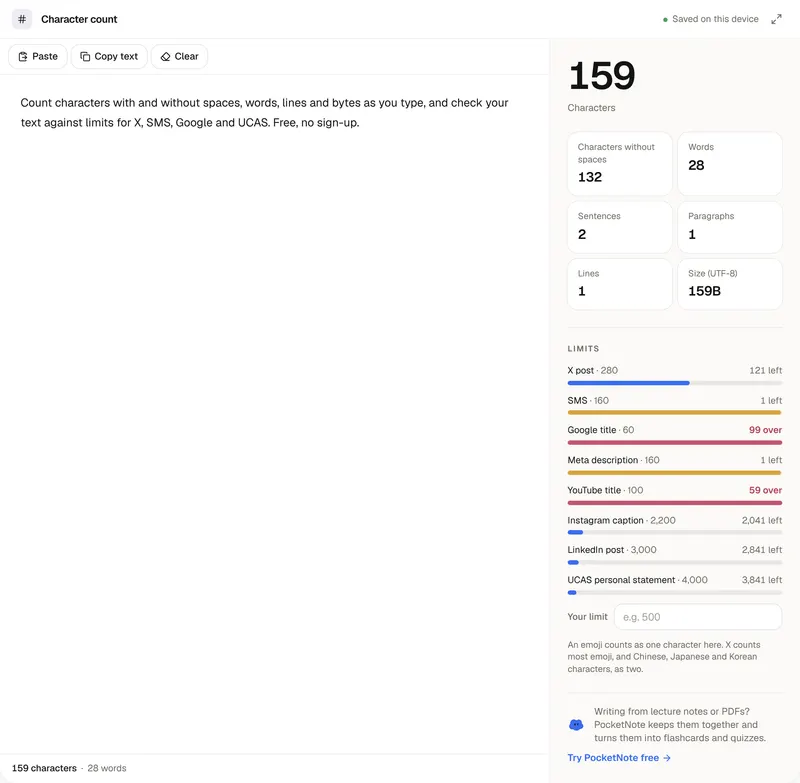
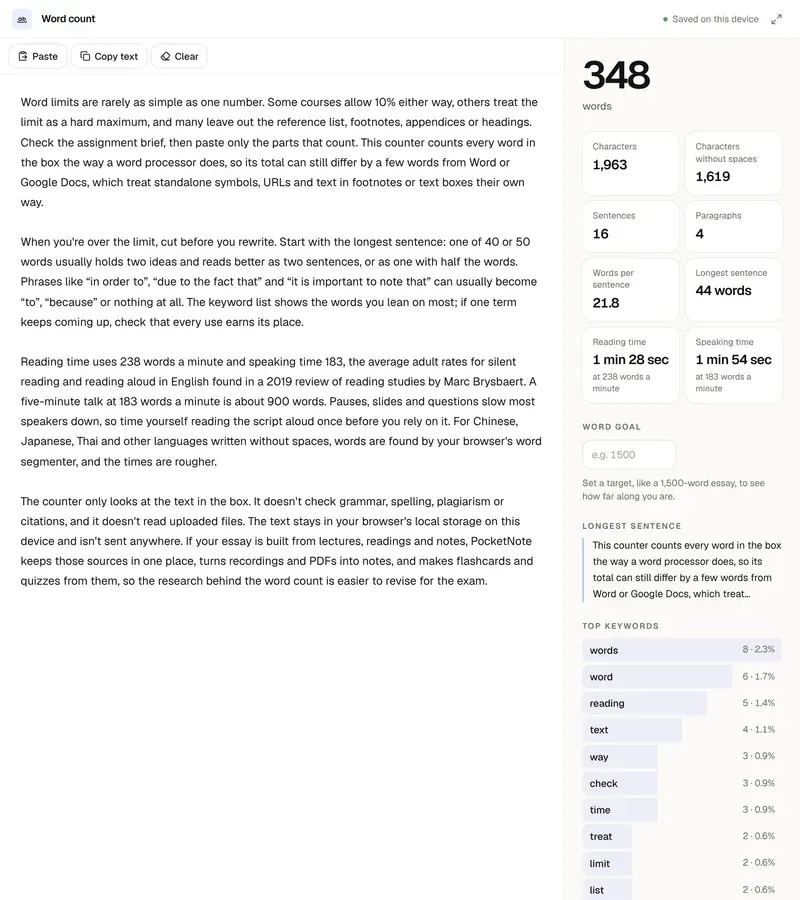
When the text looks right, copy it or download it as a .txt file. The character and word count stay in view, but for a limit use the character counter, which shows how much room is left, or the word counter for an essay. Changing case doesn't fix spelling or punctuation, so a heading that matters deserves a pass through the grammar checker too. Everything happens in your browser and nothing is uploaded. PocketNote keeps a course's lectures, PDFs and notes in one notebook and makes summaries, flashcards and quizzes from them.
FAQ
Questions, answered
Keep reading
Go deeper into the science
Less formatting, more studying
PocketNote keeps a course's lectures, PDFs and notes in one notebook and makes summaries, flashcards and quizzes from them.