
Language: English
Degree Classification Calculator
Enter your module marks and credits year by year to see your final mark and honours class under your university's own weighting, rounding and borderline rule, and the mark you need in the modules still to come. The rules of Bristol, Nottingham, Edinburgh, Leeds and the Open University are built in; for any other university, type the weights from your regulations.
- No account needed
- Free, no limits
- Nothing is uploaded
How it works
- 01
Choose your university and programme
Pick **University of Bristol**, **University of Nottingham**, **University of Edinburgh**, **University of Leeds** or **The Open University**, then your programme type, which sets the year weighting. For anywhere else, choose **Other university (your own rules)** and type each year's weight from your handbook.
- 02
Enter module marks and credits
Add each module under its year with its credits and final mark. Leave the mark empty for modules you have not finished yet; the class column shows where each mark sits. Open University students pick a level, credits and grade instead.
- 03
Read your class and what you need
The result shows your final mark or average so far, your class, the borderline check under your university's rule, every step of the working, and the lowest mark you need in each remaining module for a First, 2:1, 2:2 or Third.
How UK degrees are classified
Year weightings, rounding and the borderline rule
Your honours class comes from a weighted average of your module marks. Each module counts by its credits within its year, and each year counts by the weighting in your university's regulations, so a 40-credit dissertation weighs four times as much as a 10-credit module. At the four universities in this calculator that use percentage marks, the boundaries are the same: First from 70, upper second (2:1) from 60, lower second (2:2) from 50 and Third from 40 (a Bristol integrated master's has no Third). The weighting is what differs: Bristol uses 0:40:60 or 0:25:75 for a three-year bachelor's depending on the faculty, Nottingham 33% for Part I and 67% for Part II, Leeds 1:2 between years 2 and 3, and Edinburgh counts every credit of the two honours years the same.
Rounding and borderlines decide close cases. Bristol rounds unit marks, year marks and the final programme mark to whole numbers; a final mark of 68–69, 58–59 or 48–49 is borderline, and you get the higher class if 50% or more of your unit marks, weighted by credits and year, are at that class or above. Nottingham rounds module marks and the final average, x.5 going up; a 69, 59 or 49 is borderline, and the higher class is given if two thirds or more of your final-stage credits, or of your final and penultimate stage credits, are in it. Leeds keeps one decimal place and gives the higher class within 0.5 of a boundary. Edinburgh does not round the overall mean at all: 68.00 to 69.99 is borderline, and the Board of Examiners decides on factors it publishes in advance.
| University | What counts | Rounding | Borderline |
|---|---|---|---|
| Bristol | Years 2 and 3: 40/60 or 25/75 (three-year bachelor's) | Unit, year and final marks to whole numbers | 68–69, 58–59, 48–49: higher class with 50% of weighted credits in it |
| Nottingham | Part I 33%, Part II 67% | Module marks and final average to whole numbers | 69, 59, 49: higher class with two thirds of final-stage credits, or of the last two stages' credits, in it |
| Edinburgh | Honours years 3 and 4, every credit equal | Course marks to whole numbers, mean not rounded | 68.00–69.99 and so on: the Board decides |
| Leeds | Years 2 and 3, weighted 1:2 | Average to one decimal place | Within 0.5 of a boundary: higher class |
| Open University | 120 Level 2 and 120 Level 3 credits, Level 3 doubled | Score bands | Within 60 points: 60 Level 3 credits at the higher grade |
The Open University works differently: each module has a grade from 1 (Distinction) to 4, your score is credits × grade over 120 Level 2 and 120 Level 3 credits with Level 3 counted twice, and a lower score is better. With 240 such credits, 630 or less is a First, 631–900 a 2:1 and 901–1170 a 2:2. Common mistakes elsewhere: averaging marks without credits, counting first year when your university does not, using another university's weighting, and assuming that every university rounds 69.5 up to a First.
Limits. The calculator applies the published rules to the marks you type. It does not know about exceptional circumstances, capped resit marks, must-pass modules, credit from elsewhere or programmes with their own weightings, and integrated master's students at Leeds also need an average of 50.0 over their level 7 credits. Universities in Ireland and elsewhere in the UK publish their own rules; if yours classifies on percentage marks with year weights, Other university applies them. Your official class comes from your exam board.
FAQ
Questions, answered
More free tools
Planning & grades
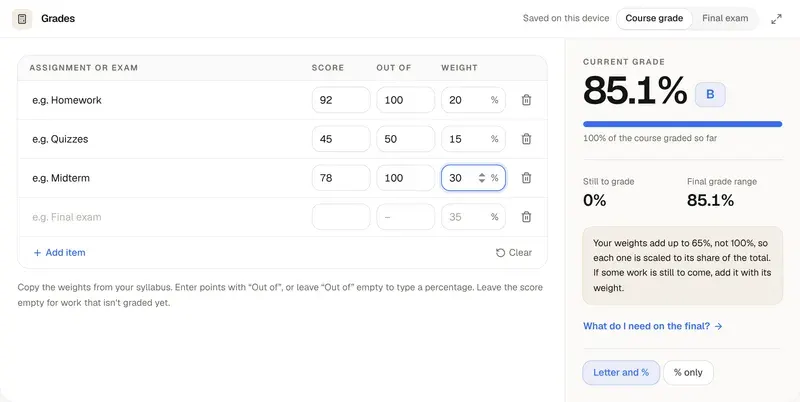
Grade Calculator
Your weighted grade, and what you need on the final.
Planning & grades
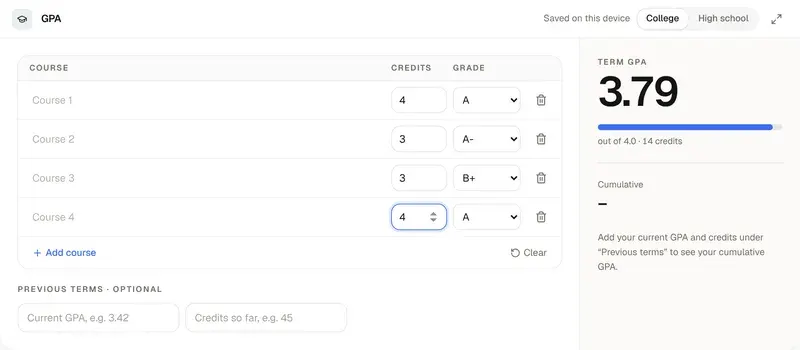
GPA Calculator
College or high school GPA, weighted or unweighted.
Planning & grades
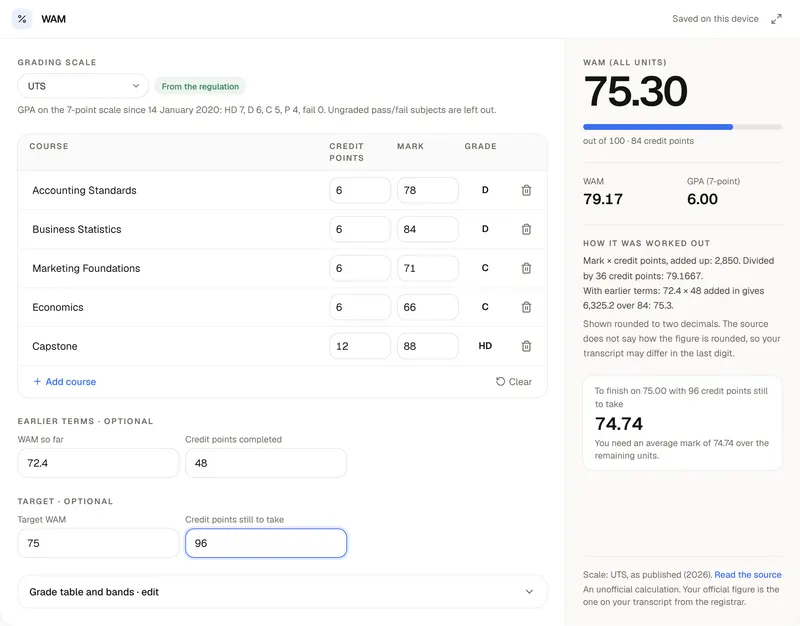
WAM Calculator
WAM from marks and credit points, with the 7-point GPA.
Planning & grades
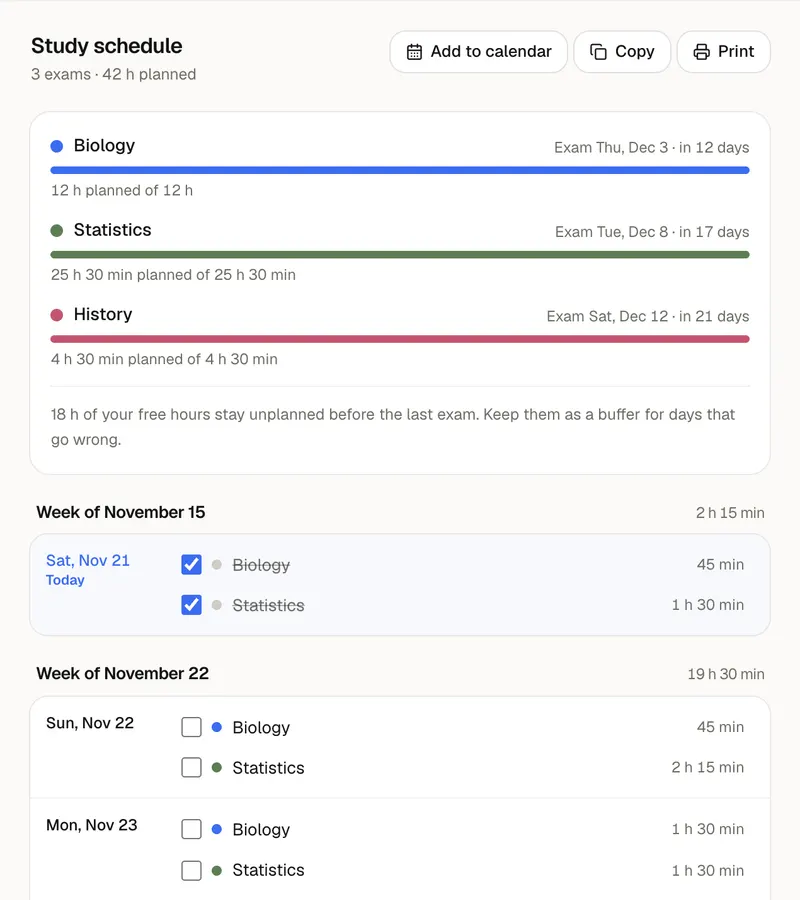
Study Schedule Maker
Your exams and free hours in, a day-by-day study plan out.
Keep reading
Go deeper into the science
Make the modules still to come count
PocketNote turns your lecture notes into flashcards and quizzes and plans your revision until exams.