
共通テスト Score Calculator
Type your 自己採点 subject by subject. The calculator knows the full marks of every subject of the January 2027 test, adds up your 素点 and 得点率, and converts them to the 配点 you copy from a university's 募集要項, including guides that compress 英語 or the whole total, with the working shown.
- No account needed
- Free, no limits
- Nothing is uploaded
How it works
- 01
Choose your subjects
Pick the subject you sat in each group, with your first and second answered subjects (第1解答科目, 第2解答科目) in 地歴・公民 and 理科. The full marks of each subject are filled in for you.
- 02
Type your scores and the 配点
Enter your self-marked scores, then the 配点 from the university's 募集要項 or 選抜要項. Type 0 for a subject the university does not use.
- 03
Check the working
See your 素点, your total in the university's 配点 and the 得点率, with the multiplication for every subject. Add a ボーダー得点率 to see how far above or below it you are.
How 共通テスト scores are converted
The same scores, a different total at every university
The 大学入学共通テスト of 16 and 17 January 2027 is marked on full marks set by the 大学入試センター: 国語 200 (近代以降の文章 110, 古典 90), 英語 リーディング 100 and リスニング 100, 数学① and 数学② 100 each, 100 for each 地理歴史・公民 and 理科 subject, with at most two in each group, and 情報Ⅰ 100. 『地理総合/歴史総合/公共』 and 『物理基礎/化学基礎/生物基礎/地学基礎』 each count as one subject, made of two 50-point areas. ドイツ語, フランス語, 中国語 and 韓国語 are one written paper of 200 points with no listening. Your 素点 and its 得点率 are the same whichever university you apply to.
Each university then counts those scores with its own 配点, published in its 募集要項 or 選抜要項. The conversion is proportional: converted score = your score × 配点 ÷ full marks. 京都大学法学部 converts 英語 リーディング to 150 points and リスニング to 50, so 85 in リーディング becomes 85 × 150 ÷ 100 = 127.5. Some guides convert a second time: the same faculty adds its subjects up to 950 points and converts that total to 285. 同志社大学 converts リーディング to 200 and リスニング to 100, then compresses the 300 points of 英語 to 200. 広島大学, where 理科 can be one 基礎 subject or two others, multiplies the total of the two others (200 points) by 0.5.
Most mistakes are in which scores count, not in the arithmetic. If you sat two subjects where the university uses one, its guide says which: 京都大学 and 広島大学 use your 第1解答科目 in 地歴・公民 and 理科, 広島大学 takes the higher score of two 数学 subjects, and 日本大学松戸歯学部 uses the higher score in its 共通テスト利用 subject groups. Give the subject that does not count a 配点 of 0. Check too whether リスニング is used at all (日本大学松戸歯学部's 2027 共通テスト利用 uses 英語 without it) and whether converted scores are rounded (the same guide rounds them to one decimal place).
The calculator works with your self-marked scores. It cannot include 得点調整: the 大学入試センター plans to announce on 22 January 2027 whether it raises scores in 地理歴史, 公民 or 理科 subjects to even out a difference in difficulty, and an adjustment never lowers a score. There are no university presets, because 配点 differ by faculty and can change from year to year: copy them from the current guide. It does not predict whether you pass either. A ボーダー得点率 from a cram school is a prediction (河合塾's is the line where it expects a 50 % chance of passing), and the official scores reach each university from the 大学入試センター.
| Group | Subjects | Full marks |
|---|---|---|
| 国語 | 『国語』 (近代以降の文章 110, 古典 90) | 200 |
| 地理歴史・公民 | Up to two of 『地理総合,地理探究』『歴史総合,日本史探究』『歴史総合,世界史探究』『公共,倫理』『公共,政治・経済』『地理総合/歴史総合/公共』 | 100 each |
| 数学① | 『数学Ⅰ,数学A』 or 『数学Ⅰ』 | 100 |
| 数学② | 『数学Ⅱ,数学B,数学C』 | 100 |
| 理科 | Up to two of 『物理基礎/化学基礎/生物基礎/地学基礎』『物理』『化学』『生物』『地学』 | 100 each |
| 外国語 | 『英語』 リーディング + リスニング | 100 + 100 |
| 外国語 | 『ドイツ語』『フランス語』『中国語』『韓国語』 (筆記) | 200 |
| 情報 | 『情報Ⅰ』 | 100 |
FAQ
Questions, answered
More free tools
Planning & grades
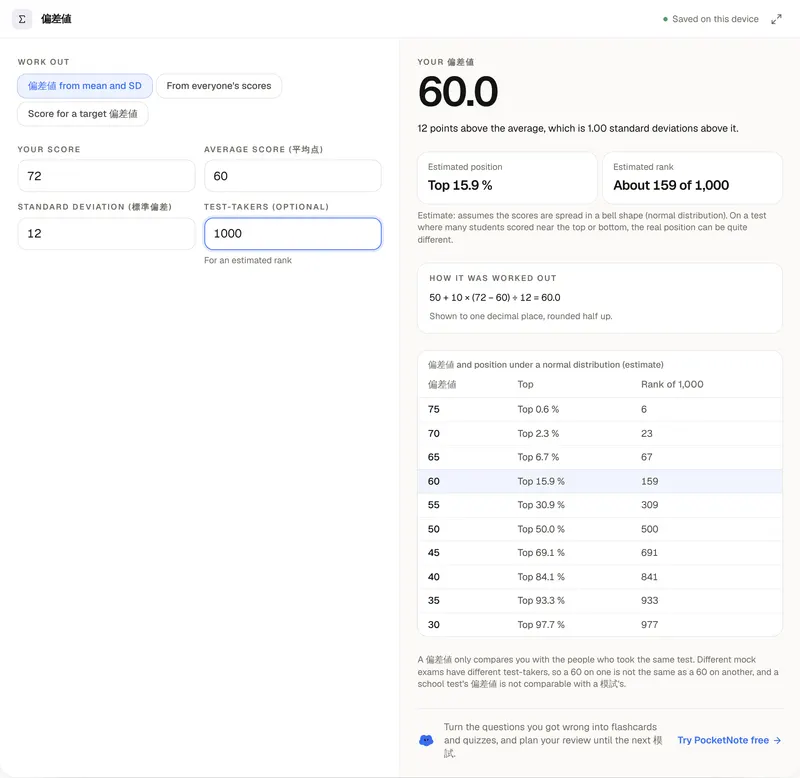
偏差値 Calculator
Your 偏差値, the score you need, and what it means.
Planning & grades
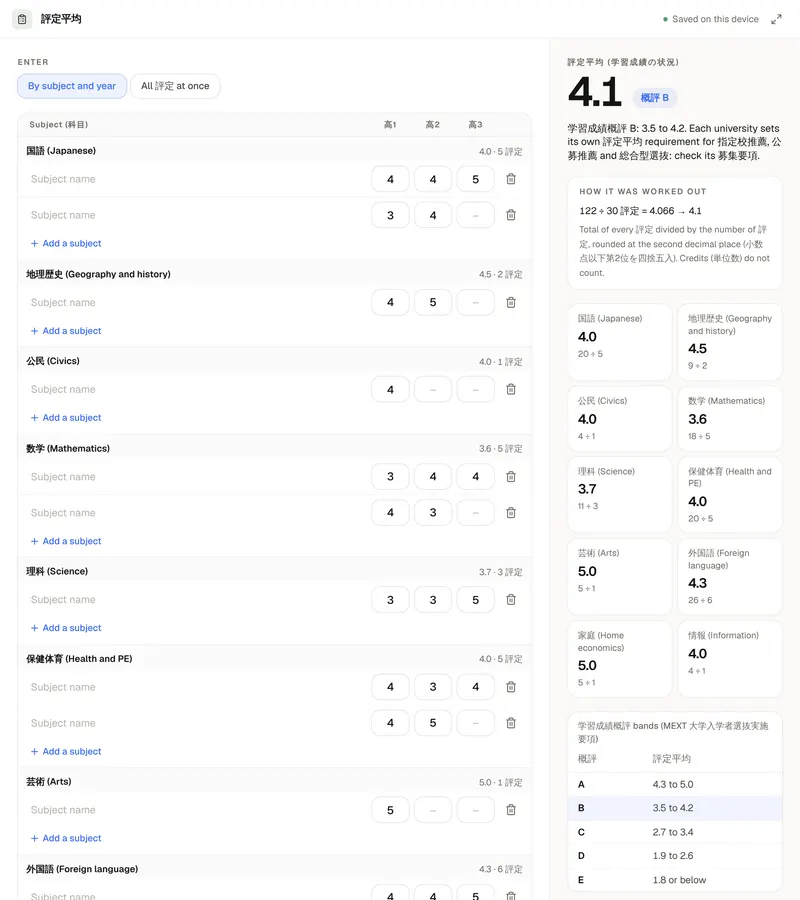
評定平均 Calculator
Your 評定平均 and 概評, by MEXT's 調査書 rule.
Planning & grades
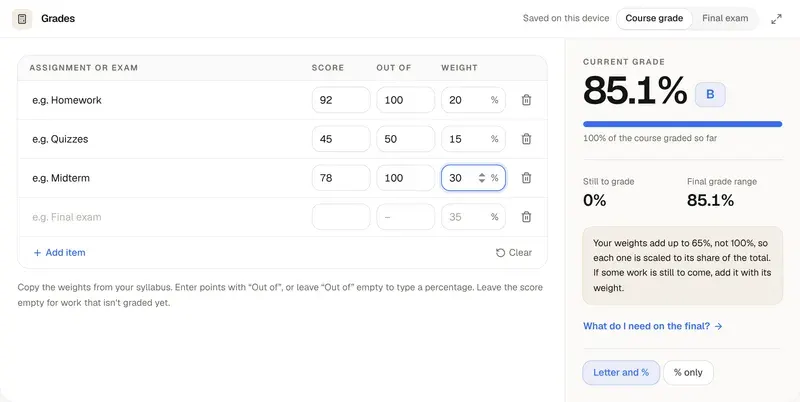
Grade Calculator
Your weighted grade, and what you need on the final.
Planning & grades
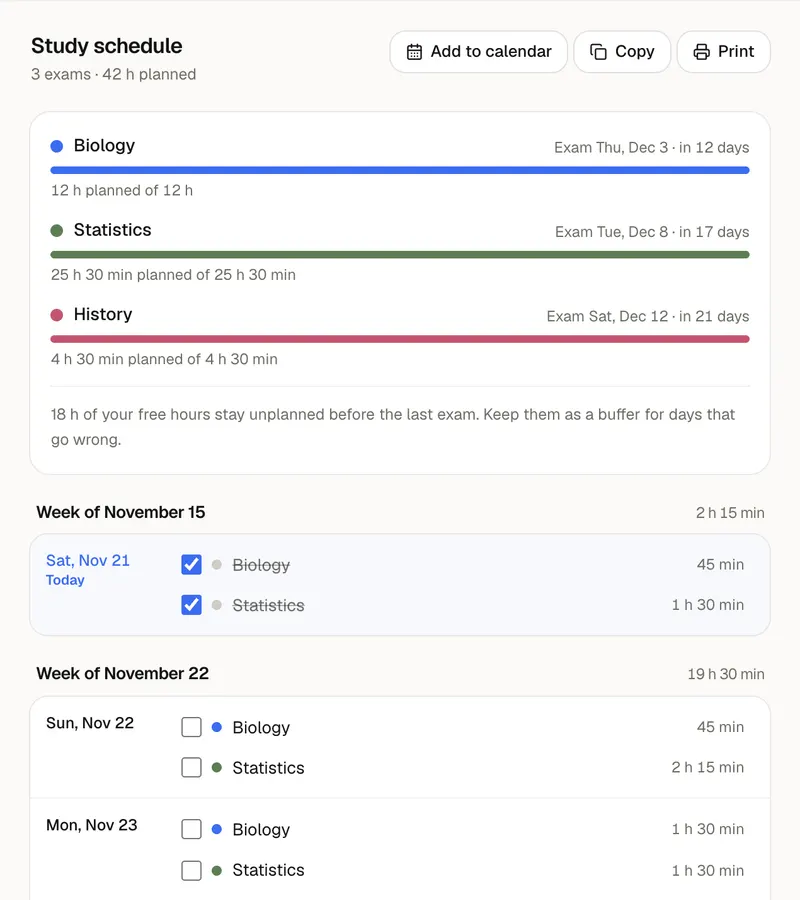
Study Schedule Maker
Your exams and free hours in, a day-by-day study plan out.
Keep reading
Go deeper into the science
Review for the next exam from your own notes
PocketNote turns your notes and the questions you got wrong into flashcards and quizzes, and plans your study for the exams still ahead.