
내신 등급 Calculator
Choose the 5-grade system (entered high school in 2025 or later) or the 9-grade system, then enter the number of students and your rank to get your 석차등급 with every grade's cut-off and the 중간석차 rule for ties. Or enter your subjects to get your average grade weighted by 학점 or 단위수.
- No account needed
- Free, no limits
- Nothing is uploaded
How it works
- 01
Choose your grading system
5 grades if you entered high school in 2025 or later (2022 개정 교육과정), 9 grades if you entered in 2024 or earlier (2015 개정 교육과정).
- 02
Enter your rank or your subjects
For one subject: the number of students (수강자수), your rank (석차) and how many share it, typed as 12(3) if you like. For an average: each subject's 학점 or 단위수 and 석차등급, semester by semester.
- 03
Check the working
The result shows how many students each grade holds, the 중간석차 calculation when tied students cross a grade line, and the weighted sum behind your average.
How 석차등급 is worked out
Cumulative shares, rounded head-counts and the 중간석차 rule
Every subject that gets a 석차등급 ranks its students by their total from 정기시험 and 수행평가, and your grade follows from how many students are at or above your rank. Students who entered high school in 2025 or later follow the 2022 개정 교육과정 and have five grades: 1등급 for the top 10 %, then up to 34 %, 66 % and 90 % for 2등급 to 4등급, and 5등급 for the rest. Students who entered in 2024 or earlier have nine grades with cumulative shares of 4, 11, 23, 40, 60, 77, 89, 96 and 100 %. On the 5-grade system the 학교생활기록부 shows the 석차등급 next to an achievement level (성취도).
The grades are not cut at exact percentages but at rounded head-counts: the guideline multiplies the number of students (수강자수) by each cumulative share and rounds (반올림). With 96 students, 96 × 10 % = 9.6, so ranks 1 to 10 get 1등급. With 4 students, 4 × 10 % = 0.4 rounds to 0, so nobody can get 1등급. Tied students all get the best rank of the group, written with the number tied, such as 12(3). When a tied group crosses a grade line, the guideline uses the 중간석차: rank + (number tied − 1) ÷ 2, divided by the number of students and compared with the shares. In its own example, 96 students with 19 tied for first give 10 ÷ 96 = 10.42 %, above 10 %, so all 19 get 2등급 and nobody gets 1등급.
Your average 내신 grade weights each subject by its credits: Σ(석차등급 × 학점) ÷ Σ학점, with 단위수 in place of 학점 on the 9-grade system. 고려대학교 gives this formula for its 교과평균등급 in its 2027 수시 guide. Only subjects with a 석차등급 belong in it. On the 5-grade system, 체육·예술 subjects (except a 특목고's own 선택 과목), 과학탐구실험, 교양 subjects, the nine social-studies and science 융합 선택 subjects such as 여행지리 and 융합과학 탐구, and subjects taken through 공동교육과정 or an 온라인학교 have none. On the 9-grade system, 진로 선택 subjects have none either. A common mistake is averaging the grades without weighting them, which lets a 1-학점 subject count as much as a 4-학점 one.
The calculator gives the plain grade and average, not a university's score. Each university picks its own subjects, decides whether to weight school years, converts grades to points with its own table and has its own rules: 고려대학교's 2027 학교추천전형, for example, adjusts the 석차등급 of subjects with 12 or fewer students and converts subjects graded only by 성취도. The calculator also does not convert between 5 and 9 grades: the guideline gives no conversion, and the two systems cut at different shares. With 5 or fewer students (13 or fewer on the 9-grade system) the school may record ㆍ instead of a grade. Your 학교생활기록부 is the official record; check each university's 모집요강 for how it counts it.
FAQ
Questions, answered
More free tools
Planning & grades
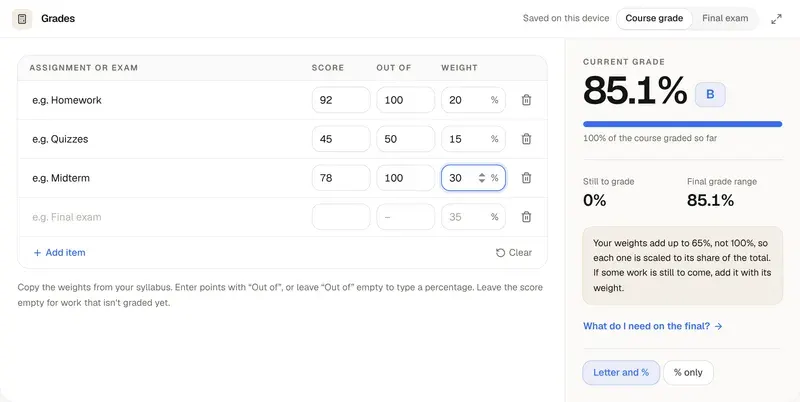
Grade Calculator
Your weighted grade, and what you need on the final.
Planning & grades
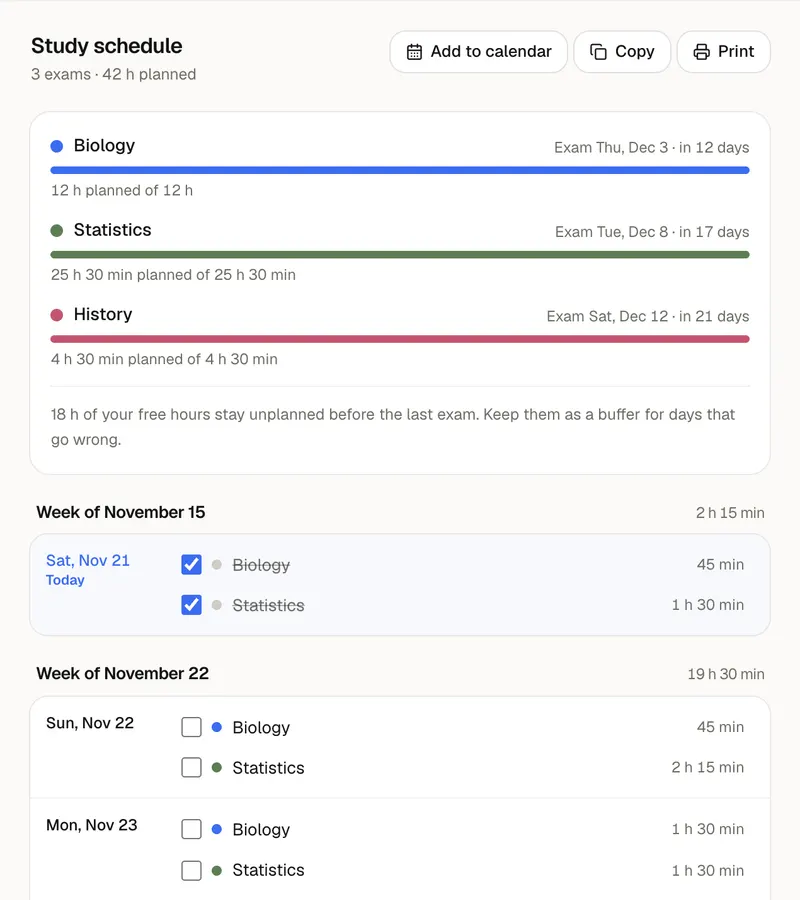
Study Schedule Maker
Your exams and free hours in, a day-by-day study plan out.
AI study tools
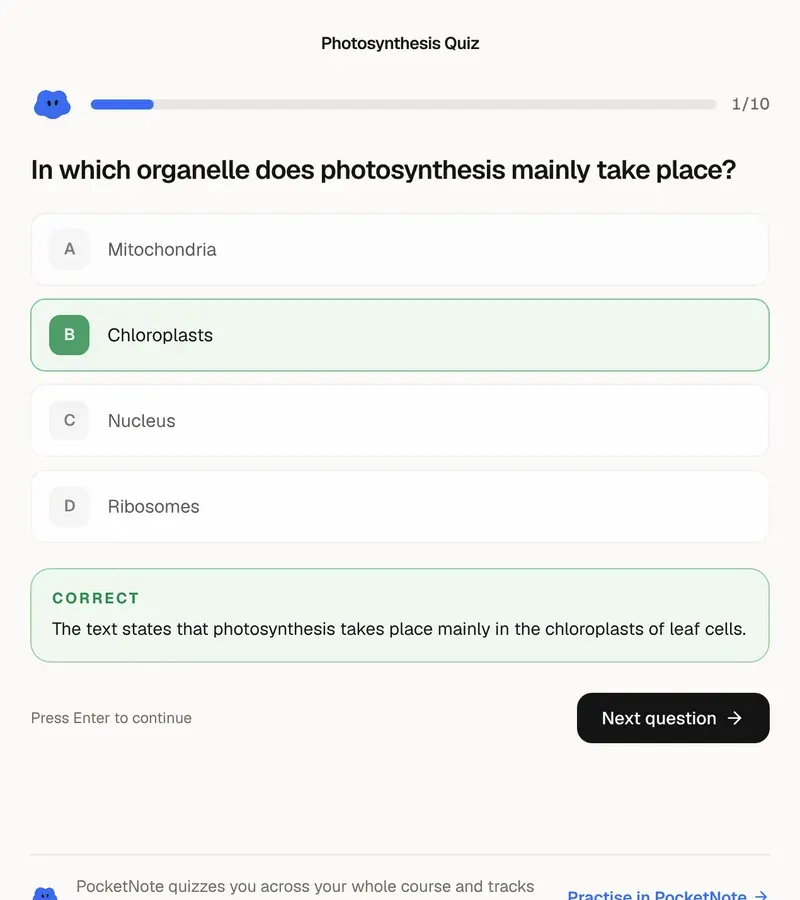
AI Quiz Generator
Practice questions from your own material, with answers explained.
Planning & grades
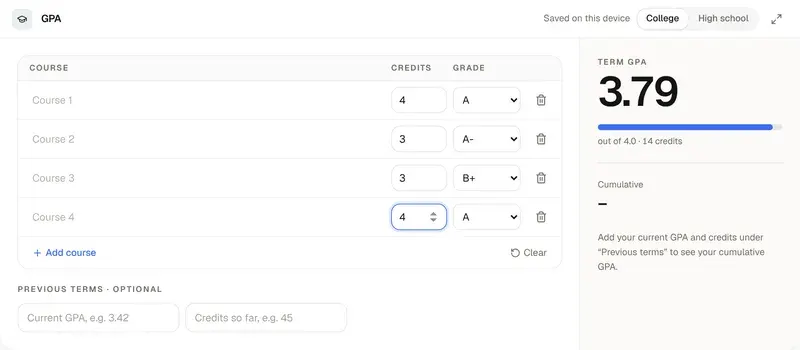
GPA Calculator
College or high school GPA, weighted or unweighted.
Keep reading
Go deeper into the science
Prepare for the next 정기시험 with steady review
PocketNote turns your notes into flashcards and quizzes and plans your study up to the next exam.