
Reading Time Calculator
Enter a word count or paste your text to see how long it takes to read silently and how long it takes to say out loud. Pick a reading speed and a speaking pace, or set your own, and get the “min read” label blogs use.
- No account needed
- Free, no limits
- Nothing is uploaded
How it works
- 01
Enter words or paste text
Type a word count, or paste your script or article and the words are counted for you.
- 02
Choose the speeds
For reading: Slow (150 words a minute), Average (238) or Fast (300). For speaking: Presentation (130), Conversational (150) or Reading aloud (183). You can enter your own speed for either.
- 03
Use the times
Read off the silent reading time, the speaking time and the “min read” label, which is rounded up to a whole minute.
Reading and speaking time
Time a talk in words, then rehearse
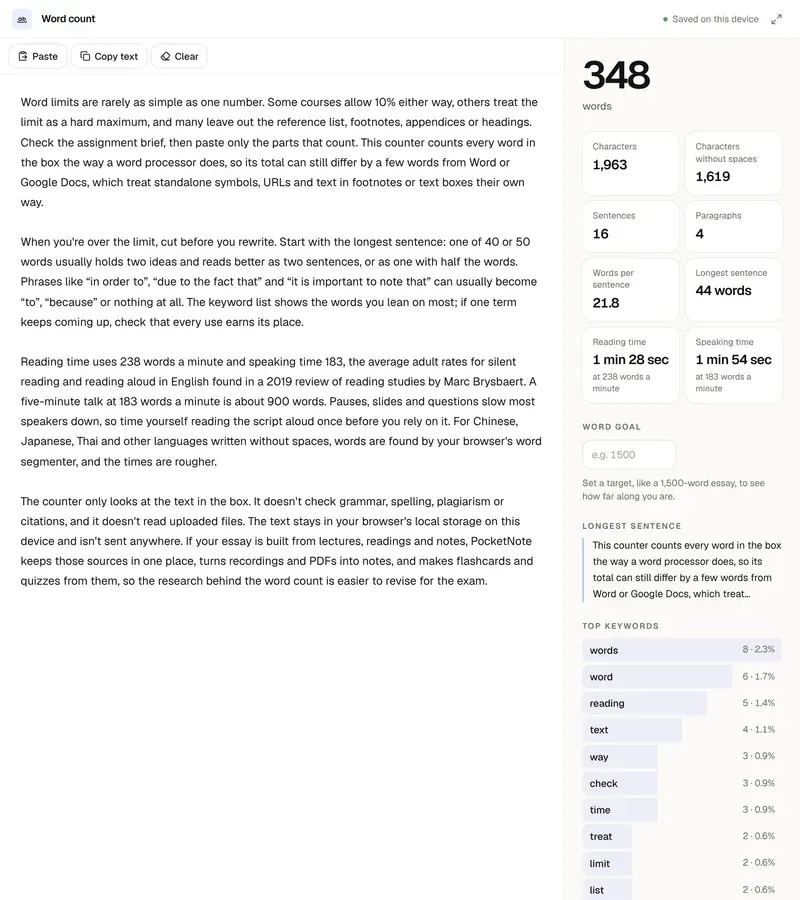
Reading time is a word count divided by a speed, so the result is only as good as the speed you pick. The Average reading speed here is 238 words a minute and the Reading aloud speed is 183. Those are the average adult rates for silent reading and for reading aloud in English, from a 2019 review of reading studies by Marc Brysbaert, and they are the same figures the word counter uses. Slow (150) suits a careful reader or a hard text, Fast (300) a quick reader on easy material. If you know your own speed, enter it. The “min read” label is the silent reading time rounded up to a whole minute.
| Words | Reading silently (238 wpm) | Speaking (150 wpm) |
|---|---|---|
| 250 | 1 min | 1.5 min |
| 500 | 2 min | 3.5 min |
| 750 | 3 min | 5 min |
| 1,000 | 4 min | 6.5 min |
| 1,500 | 6.5 min | 10 min |
| 2,000 | 8.5 min | 13 min |
| 3,000 | 13 min | 20 min |
| 5,000 | 21 min | 33 min |
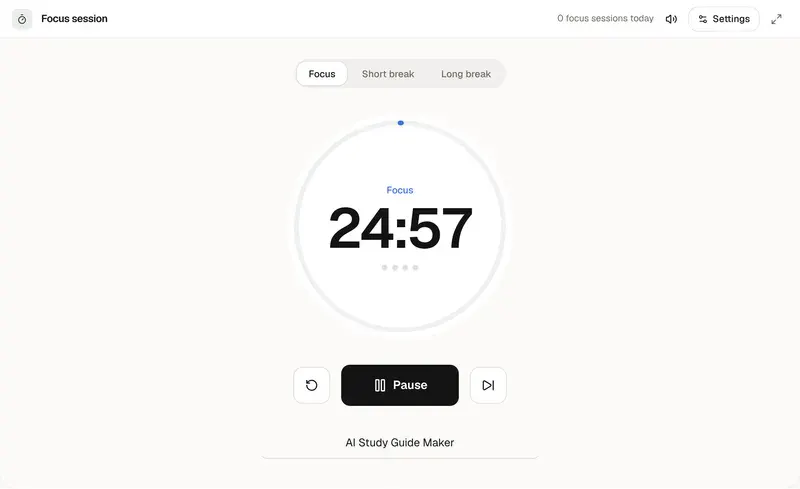
For a speech or a presentation, work from the speaking pace. Presentation pace is 130 words a minute, slower than conversation, because an audience needs time to follow. A five-minute talk is about 650 words at that pace, and a ten-minute talk about 1,300. Write to a little under the target: pauses, slides, a joke that gets a laugh and questions from the room all add time, and almost nobody finishes early. Then rehearse out loud with a timer, such as the study timer, and cut the script until you come in under your slot. The calculator gets you close; the rehearsal tells you the truth.
The same sum helps with reading. Paste a chapter or an article to see roughly how long it takes, then plan your session around it. Expect dense or technical text to go slower than the estimate, because you stop to reread and take notes. For languages written without spaces between words, such as Chinese, Japanese and Thai, the words are found by your browser's word segmenter and the times are rougher. Text you paste stays in your browser and isn't uploaded. PocketNote keeps a course's lectures, PDFs and notes in one notebook and makes summaries, flashcards and quizzes from them.
FAQ
Questions, answered
Know the material before you present
PocketNote keeps a course's lectures, PDFs and notes in one notebook and makes summaries, flashcards and quizzes from them.