
Simulateur bac
Enter your exam marks and the annual averages from your bulletins. The simulator applies the coefficients of the 2027 session of the bac général or technologique, gives your average out of 20 with the mention or the second group, and the average you still need in the marks to come.
- No account needed
- Free, no limits
- Nothing is uploaded
How it works
- 01
Choose your voie
Pick bac général or bac technologique. Philosophie and the Grand oral do not have the same coefficient in the two, so the simulator waits for your choice.
- 02
Type your marks
Enter your épreuves anticipées (français écrit and oral, mathématiques), your real or expected marks in philosophie, the Grand oral and your two spécialités, and the annual averages of the contrôle continu. Add your options, one line per year.
- 03
Read the result and the working
See your average out of 20, the mention, the second group or ajourné, the average you need in the marks still to come for the aim you choose, and every line of mark × coefficient behind it.
How the bac average is calculated
60 coefficients of exams, 40 of contrôle continu
The bac général and the bac technologique are awarded on one average out of 20: each mark is multiplied by its coefficient, and the total is divided by the sum of the coefficients. The compulsory coefficients add up to 100, so the total is out of 2,000 points: 60 for the épreuves terminales and 40 for the contrôle continu. The épreuves terminales are the épreuves anticipées at the end of première (français écrit and oral, and mathématiques from the 2027 session), then philosophie, the Grand oral and your two spécialités in terminale. The contrôle continu takes the annual averages on your bulletins: the spécialité you dropped after première, histoire-géographie, LVA, LVB, enseignement scientifique (voie générale) or mathématiques (voie technologique), EPS in terminale and EMC. The figures below are those of the Eduscol memento on bac assessment (September 2025), with the Grand oral as set for 2027.
| Mark | Bac général | Bac technologique |
|---|---|---|
| Français écrit, épreuve anticipée | 5 | 5 |
| Français oral, épreuve anticipée | 5 | 5 |
| Mathématiques, épreuve anticipée | 2 | 2 |
| Philosophie | 8 | 4 |
| Grand oral | 8 | 12 |
| Spécialité 1 and spécialité 2 | 16 each | 16 each |
| Spécialité dropped after première (annual average) | 8 | 8 |
| Histoire-géographie, LVA, LVB (per year) | 3 each | 3 each |
| Enseignement scientifique / mathématiques (per year) | 3 | 3 |
| EPS (terminale) | 6 | 6 |
| EMC (per year) | 1 | 1 |
| Each option, per year | +2 | +2 |
What changed for 2027. The 2027 session is the first with the épreuve anticipée de mathématiques, which students then in première sat in June 2026, at coefficient 2. To keep the épreuves terminales at 60, the Grand oral went down from 10 to 8 in the voie générale and from 14 to 12 in the voie technologique (notes de service of 10 September 2026, BO spécial n° 4). A simulator that still uses 10 and 14 is out of date for you. The outcome rules have not changed: after the first group, an average of 10 or more means admis, with the mention Assez bien from 12, Bien from 14, Très bien from 16 and Très bien avec les félicitations du jury from 18 (Code de l'éducation, art. D334-11 and D336-11). From 8 to under 10 you go to the second group: two orals in subjects you choose among français, philosophie and your terminale spécialités, and mathématiques from 2027. A higher oral mark replaces your first-group mark with the same coefficient, you pass with an average of 10 over both groups, and no mention is given after the second group. Under 8 you are ajourné (art. D334-8 and D336-8).
Common mistakes. Options no longer count only for the points above 10: each option you follow adds coefficient 2 per year to the total, and its mark counts in full, even under 10, so a weak option lowers your average (the memento's own examples reach 110 and 112 coefficients). Some websites say the rattrapage now starts at 9.5: the official texts for the 2026 session and after keep 8. What did change in 2026 is the jury's margin: the jury may add at most 50 points to your total, that is 0.5 on a 100-coefficient average, and none to a candidate under 8 (décret n° 2025-1159 of 4 December 2025; note de service of 26 March 2026). Finally, the thresholds are written as an average "au moins égale à" 12, 14 and so on, with no rounding, so the simulator compares your exact average and shows it cut to two decimals: 11.996 shows as 11.99, without a mention.
Limits. The simulator is built for candidats scolaires, whose contrôle continu is made of annual averages; candidats individuels sit évaluations ponctuelles instead. It does not handle marks kept from an earlier session, candidates who failed in 2026 and are exempt from the maths exam, sections such as DNL, Abibac, Bachibac, Esabac or the BFI, or the points a jury may add. At the second group it works out philosophie, the spécialités and mathématiques, but not français, because we could not confirm in the official texts which first-group French mark the oral replaces. An average "so far" is not a forecast: the marks still to come decide it, and contrôle continu averages can still be adjusted by the academic commission d'harmonisation. Your official marks and result are on your relevé de notes after the jury's deliberation.
FAQ
Questions, answered
More free tools
Planning & grades
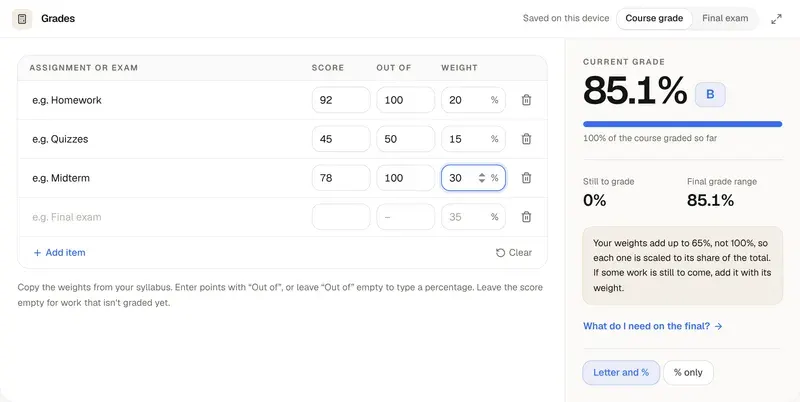
Grade Calculator
Your weighted grade, and what you need on the final.
Planning & grades
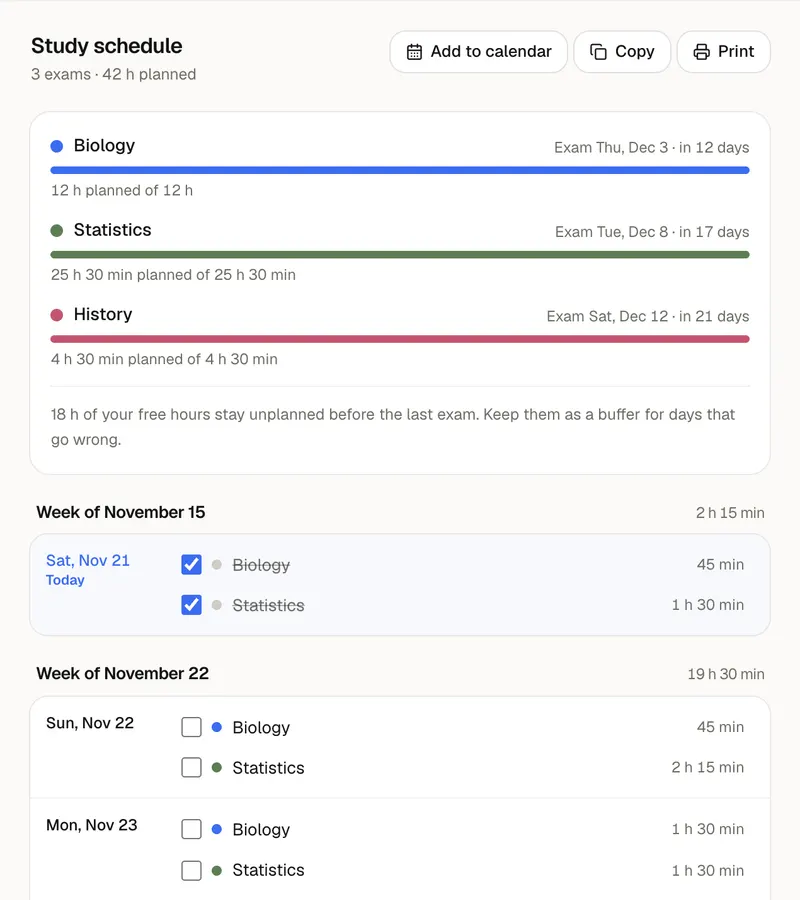
Study Schedule Maker
Your exams and free hours in, a day-by-day study plan out.
AI study tools
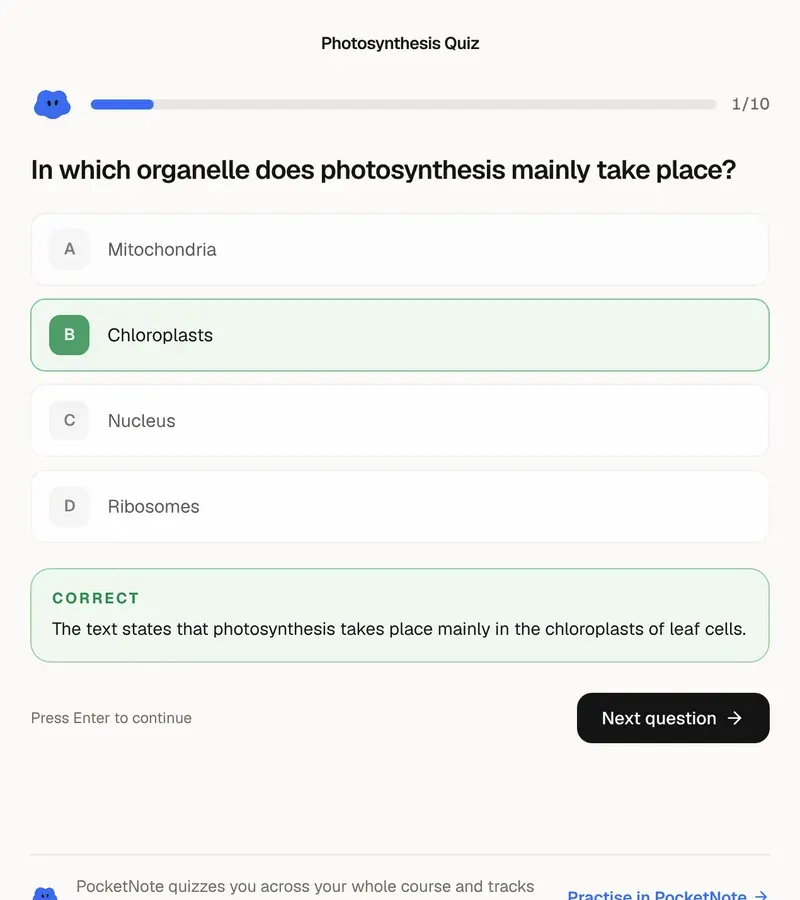
AI Quiz Generator
Practice questions from your own material, with answers explained.
Keep reading
Go deeper into the science
A better bac average starts with revision
PocketNote turns your course notes into flashcards and practice quizzes and plans your revision until the exams.