
University Grade Calculator for Türkiye
Three calculators for students at Turkish universities: your course mark from vize and final (with bütünleme) and the final you need, your dönem ortalaması and AGNO/GANO from letter grades and credits, and a çan eğrisi simulator that follows Marmara Üniversitesi's published T-score method.
- No account needed
- Free, no limits
- Nothing is uploaded
How it works
- 01
Vize and final
Enter your vize mark and the weights from your course outline (40/60 by default). Leave the final empty to see what you need, or enter it to see your course mark and whether you pass. A bütünleme mark replaces the final.
- 02
Letter grades and credits
In AGNO mode, add each course's credits (AKTS or kredi) and letter grade. Add your current AGNO and credits to get the new one. Tick “repeated course” to replace an old grade.
- 03
Match your university
Set the pass mark, the lowest final and whether marks are rounded, and pick or edit the letter table so it matches your university's regulation. Everything stays on this device.
How university grades work in Türkiye
Your senate sets the rules, the arithmetic is the same
Each course mark (başarı notu) is a weighted average of the vize (ara sınav) and the final (yarıyıl sonu sınavı): vize × 0.40 + final × 0.60 at Ankara Üniversitesi (regulation article 35). The weights are set by each university and often each faculty: Marmara Üniversitesi lets units put the final anywhere from 40% to 60%. Most universities also require a minimum mark on the final itself, so a strong vize cannot carry a weak final. At Marmara a faculty student needs at least 50 on the final and a course mark of at least 50, rounded to a whole number; at Ankara at least 50 on the final and a course mark of at least 60. A bütünleme mark takes the place of the final with the same weight.
The course mark becomes a letter grade with a coefficient on the 4.00 scale. AA 4.00, BA 3.50, BB 3.00, CB 2.50, CC 2.00, DC 1.50, DD 1.00, FD 0.50 and FF 0.00 is the most common set, but the 100-point bands differ: Marmara gives AA from 90 and CC from 65, others draw the lines elsewhere, some have no FD, and Ankara uses A, B1–B3, C1–C3, F1 and F2. AGNO/GANO is Σ(credits × coefficient) ÷ Σ credits over every course taken so far, shown to two decimals; the term average (dönem ortalaması, DNO or YANO) is the same sum for one term. A repeated course counts with its latest grade only. Many universities treat DC and DD as a pass only if your AGNO is at least 2.00.
| Mark | Letter | Coefficient |
|---|---|---|
| 90–100 | AA | 4.00 |
| 85–89 | BA | 3.50 |
| 80–84 | BB | 3.00 |
| 75–79 | CB | 2.50 |
| 65–74 | CC | 2.00 |
| 55–64 | DC | 1.50 |
| 50–54 | DD | 1.00 |
| 45–49 | FD | 0.50 |
| 0–44 | FF | 0.00 |
Çan eğrisi (bağıl değerlendirme) grades you against your class. Your T-score is 10 × (your mark − class mean) ÷ standard deviation + 50, and the class mean decides which row of the university's table applies: in a strong class a lower T-score earns the same letter. Marmara's directive spells out every step: it needs at least 30 students above the BDKL, gives FF below the BNAL or with a final under the YSSL whatever the T-score, and in an “Orta” class (mean above 47.50 up to 52.50) gives CC from T 47 and AA from T 67. The simulator follows that rule exactly and nothing else; other universities publish their own tables and limits. The YÖK figure next to your AGNO comes from YÖK's 4.00 → 100 conversion table, a straight line from 1.00 = 30 to 4.00 = 100 (3.00 = 76.66), which many applications ask for when a university has no table of its own.
Common mistakes: using the wrong weights (check the ders izlence for each course, not last year's); forgetting the final minimum; adding credits twice for a repeated course; mixing AKTS and national credits in one average; and dividing by the number of courses instead of the credits. This calculator does the arithmetic for the rules you set, so it is only as right as those rules. Your official grades and averages are the ones in your university's student information system (OBS).
FAQ
Questions, answered
More free tools
Planning & grades
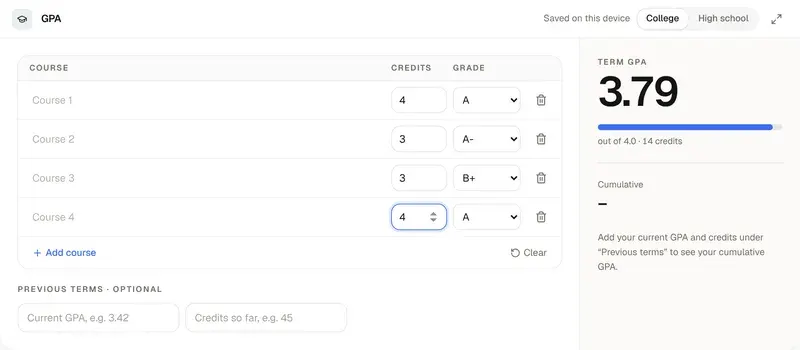
GPA Calculator
College or high school GPA, weighted or unweighted.
Planning & grades
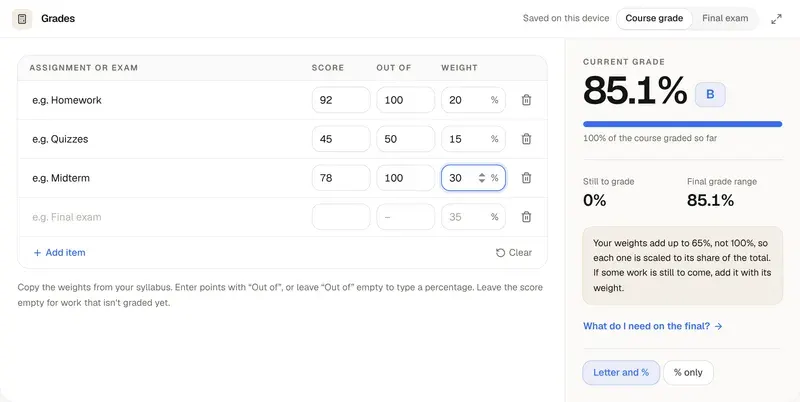
Grade Calculator
Your weighted grade, and what you need on the final.
Planning & grades
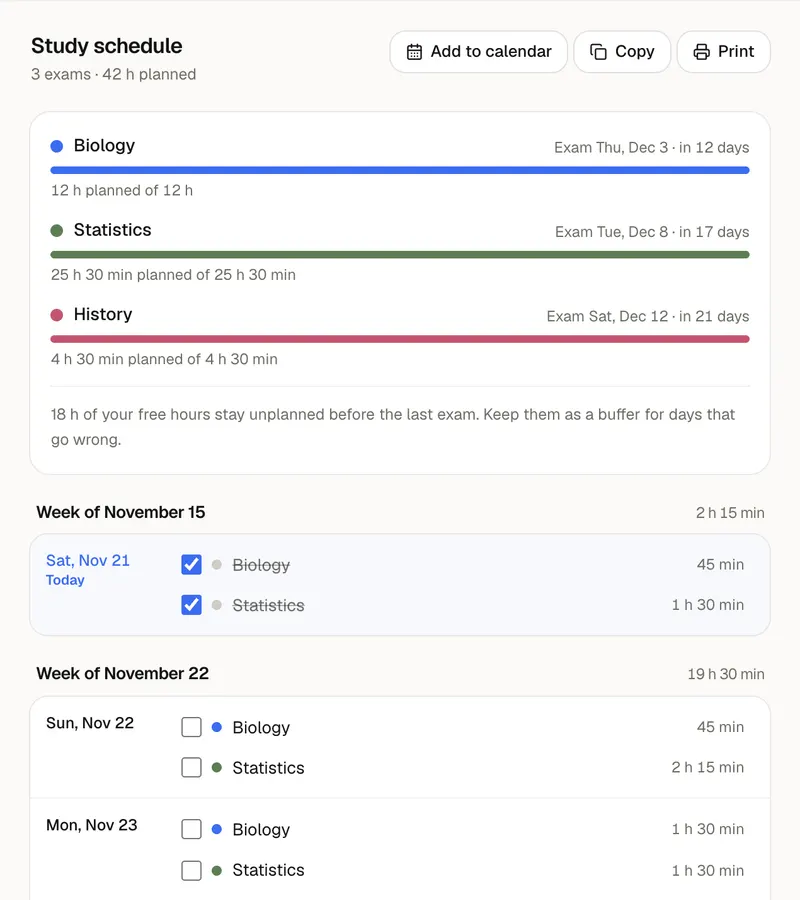
Study Schedule Maker
Your exams and free hours in, a day-by-day study plan out.
Planning & grades
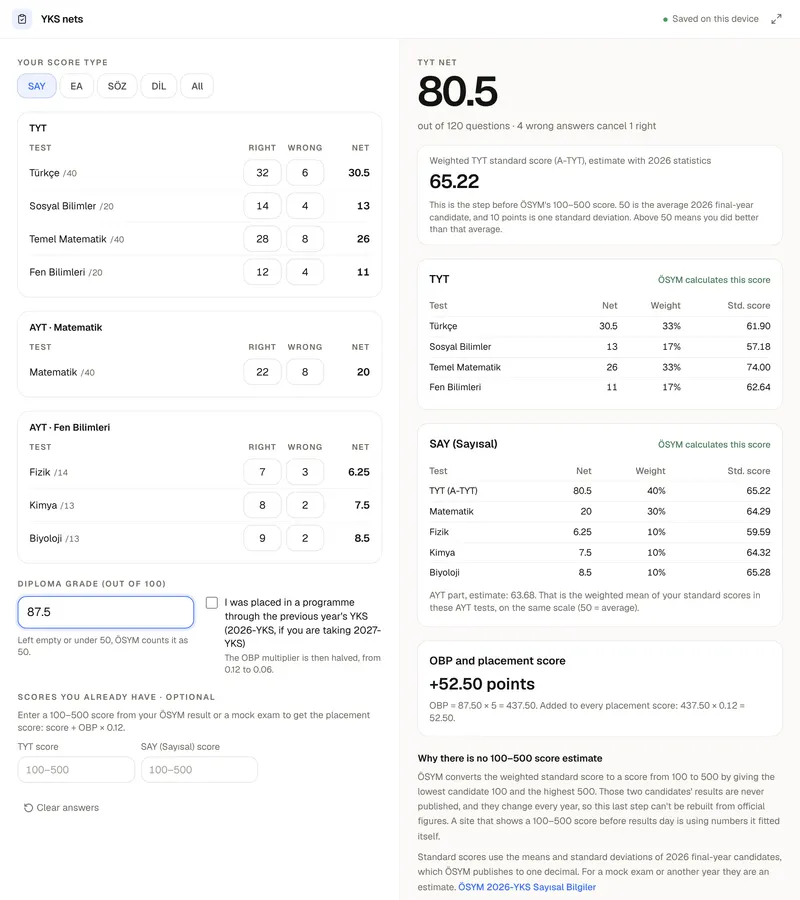
YKS Net and OBP Calculator
TYT and AYT nets, your OBP, and where your nets stood in 2026.
Keep reading
Go deeper into the science
Better finals start with earlier review
PocketNote turns your lecture notes into flashcards and quizzes and plans your study until exam week.