
Blooket is best known as a classroom game: a teacher picks a question set, hosts a live game, and students join to answer questions in modes like Gold Quest, where correct answers open treasure chests, or Tower Defense, where they earn tokens to build towers. It has a solo side too. Students with an account can search more than 20 million question sets, play them alone in selected modes, and collect characters called Blooks with the tokens they earn.
That solo side is why students end up comparing Blooket with study apps. PocketNote is one of those: you bring your lecture slides, PDFs, recordings or handwritten notes, and it generates flashcards with spaced repetition, quizzes that explain every answer and a study plan from them.
The two do different jobs, and neither is a substitute for the other. This page lays out what each does, when Blooket is the better choice, and how to use them side by side. Blooket details come from its help centre, checked in November 2026.
At a glance
PocketNote vs Blooket
| Feature | PocketNote | Blooket |
|---|---|---|
| Built for | One student studying their own course | Class games hosted by a teacher, plus solo play |
| Where questions come from | Generated from your notes, files and lectures | Sets made by teachers and users; 20M+ public sets |
| Live class games | Not offered | Yes: up to 60 players free, 300 on Plus (most modes) |
| Studying alone | Every tool is self-paced | Solo play in selected modes, with an account |
| Plain review mode | Flashcards rated Again / Hard / Good / Easy | A Study mode for solo play and homework |
| Spaced repetition | Built in | Not described in its help centre |
| Rewards | Mastery scores and progress per tool | Tokens, XP and collectible Blooks |
| Homework | Not a teacher tool | Teachers assign sets with a goal and deadline |
| Lecture recording and notes | Record lectures; typed and handwritten notes | Not advertised |
| Price | Free to start; Basic and Plus plans | Free Starter tier; paid Blooket Plus |
Checked against Blooket's help centre and PocketNote's own site, November 2026. Plans and features change; confirm current details with each product.
Why Blooket turns up in study-app searches
In class, a teacher hosts a set, everyone joins, and the mode decides the game. Each mode wraps the same questions in a different kind of play. In Gold Quest you answer questions to open chests, and the player with the most gold at the end wins; some chests let you take gold from other players. In Tower Defense, correct answers earn tokens you spend on towers that hold off waves of enemies.
But Blooket also works without a teacher. With an account you can find a public set in Discover or use one of your own, choose Play Solo, and pick a mode. The help centre lists solo support for modes including Café, Crazy Kingdom, Factory, Tower Defense, Tower Defense 2 and a plain Study mode. That is how it ends up on lists of revision tools.
Teachers can also set Blooket as homework. The teacher chooses which modes are allowed and a goal, either a number of correct answers or a number of questions, and students play towards it on their own time.
So the honest comparison is between Blooket's solo play and PocketNote's study tools. The live classroom side is Blooket's own territory, and PocketNote doesn't compete there at all.
What Blooket does well
It makes repetition enjoyable. Answering the same twenty questions five times is dull on paper and far less dull when each correct answer buys you something in a game. For memorising a fixed list, that motivation counts for a lot.
The library is enormous. Blooket's help centre says users have created more than 20 million question sets, so for many school topics there is a set ready to play the moment you search for it. Students who join a teacher's game don't need an account at all, which makes it easy to use in a class where not everyone has signed up.
It is free for most uses. The Starter tier hosts live games of up to 60 players and lets teachers set homework with deadlines up to 14 days ahead. Blooket Plus raises live games to 300 players for most modes and adds Plus-only game modes, deadlines up to 365 days, enhanced reports, folders, audio questions and verified curriculum sets.
And the reward system costs students nothing. Tokens come from answering questions in games, up to 500 tokens and 300 XP a day, and buy Blook packs in the Market; Blooket's help centre says no real money is required.
The limits of studying from a public set
A public set was written for someone else's class. The wording may not match your teacher's, it may cover a different slice of the topic, and it may contain mistakes. It's worth checking any borrowed set against your notes before you rely on it, the same as with any shared flashcard library.
A quick check before you play: open the set's preview page, read through the questions, and compare them with the topic list your teacher gave you. If half the questions are about things your class never covered, look for another set or make your own from your notes.
There is also the question of timing. Blooket's help centre doesn't describe spaced repetition, so what you review, and when, is whatever you choose to play. The game layer is the point of Blooket, and it also means part of each session goes to the game rather than to the questions.
None of this makes Blooket a bad tool. It makes it a practice tool for questions that already exist, rather than a way to learn new material from your own sources. Those are different steps in revising, and most students need both.
The same evening in PocketNote
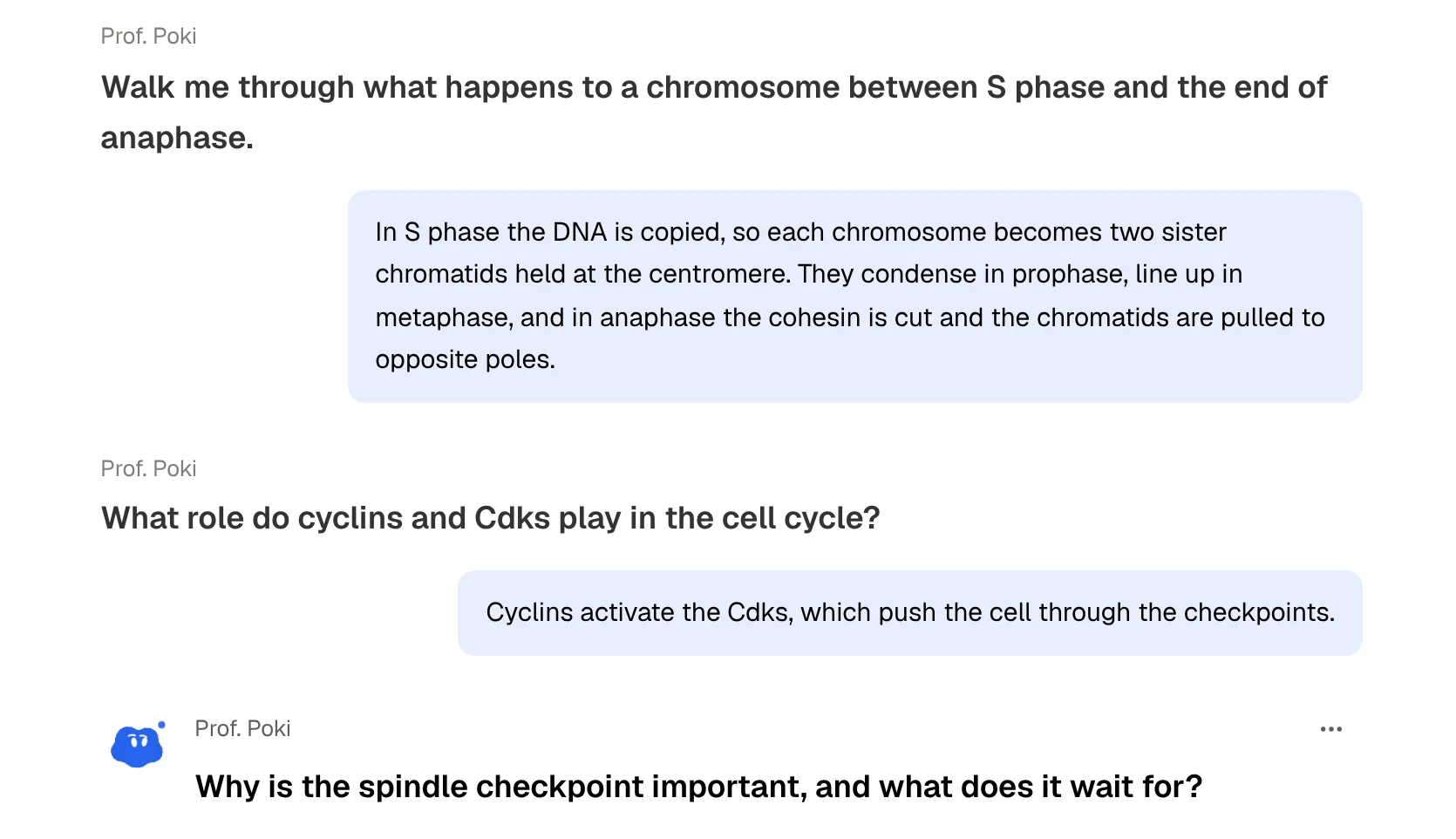
Start with your own material instead of a set. From PocketNote's home screen you can import a file, paste a YouTube or web link, import audio, record a lecture, or start a handwritten or typed note. Your teacher's handout, saved as a PDF, is a fine place to begin. If the lesson was recorded or posted as a video, paste the YouTube link and the transcript comes with it, so the questions come from what was actually said in class.
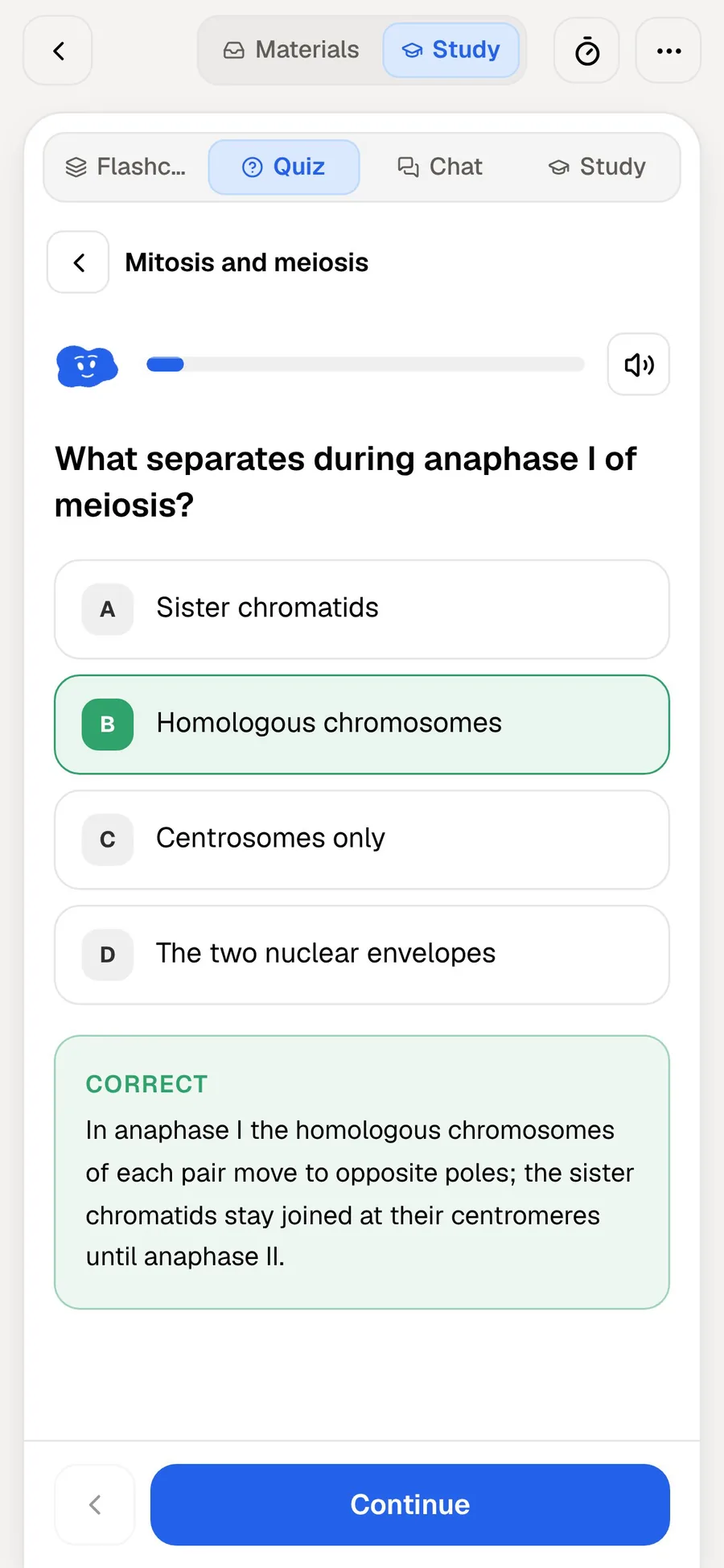
Ask for a quiz and flashcards from that handout. The quiz explains why each answer is right or wrong, so a mistake tells you what you misunderstood. The flashcards go into spaced repetition: rate each card Again, Hard, Good or Easy and it comes back when you are about to forget it.
If you get stuck, ask Poki. It answers from the handout and cites where the answer came from, and it can write a short explanation into your notes from the chat. If the test is a week away, set the date in the study plan; PocketNote plans what to cover each day and sends reminders, so the review doesn't depend on remembering to play.
Once you've worked through it, the same handout can become a mind map or a podcast-style audio review for the bus, so you meet the material in more than one form before the test.
Rewards versus a schedule
Blooket keeps you coming back with rewards: XP, tokens, a daily wheel spin and new Blooks to collect. Those are real reasons to open Blooket, and for a student who struggles to start revising, that pull matters.
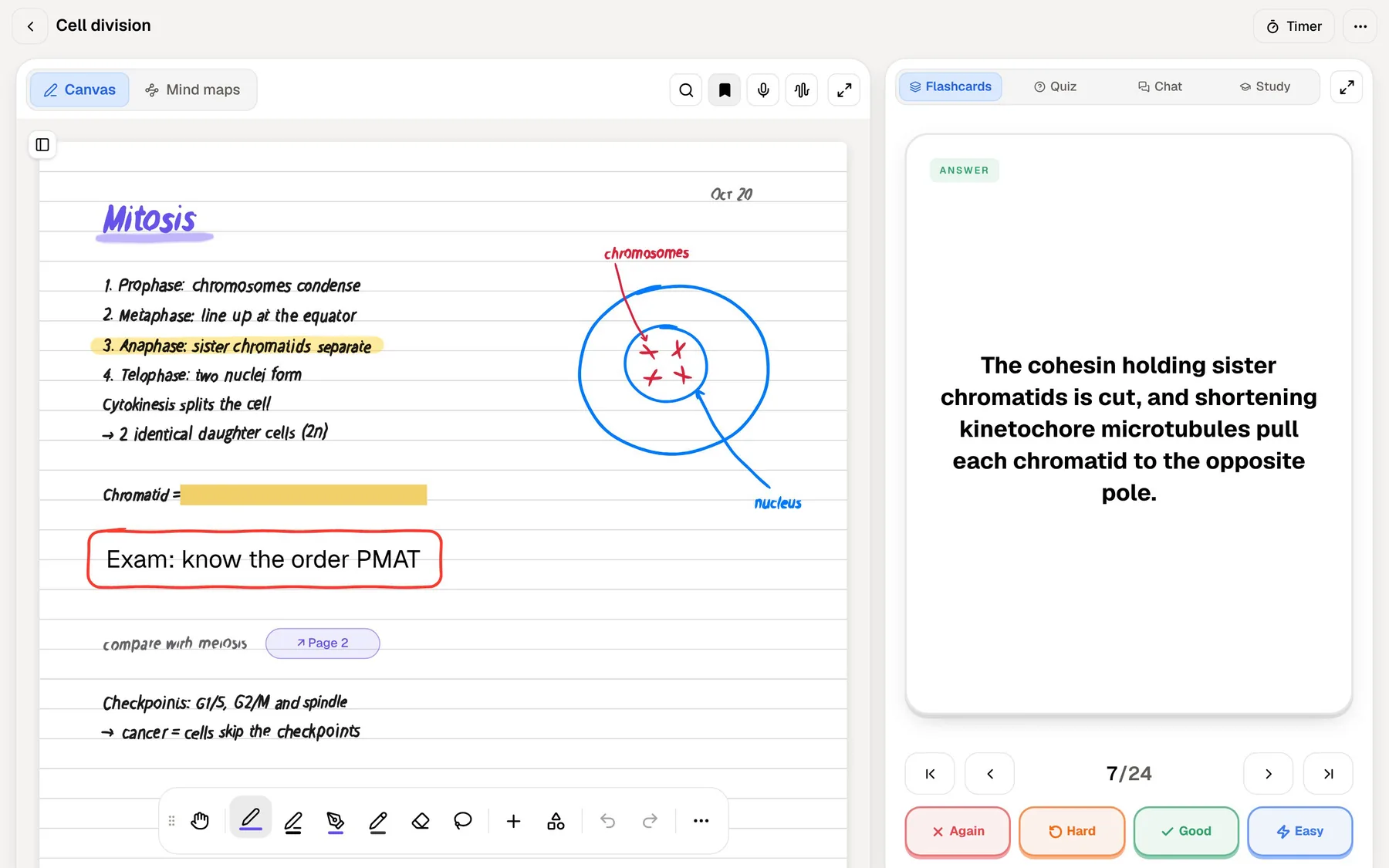
PocketNote keeps you coming back with a schedule. Cards return when you are about to forget them, the study plan sends reminders, and the mastery ring shows memory, applied and mastery scores moving as you work. Progress is tracked for each tool you use, from flashcards and quizzes to the oral exam and audio reviews.
It's less fun to look at and more direct about what you still need to learn. Which one works better for you depends on whether your problem is starting to revise or knowing what to revise.
Explaining it, not just picking it
A game round rewards quick, correct answers to questions someone else wrote, which is good practice for recognising the right answer. Many tests also ask you to explain: why a process happens, how two ideas differ, what a result means.
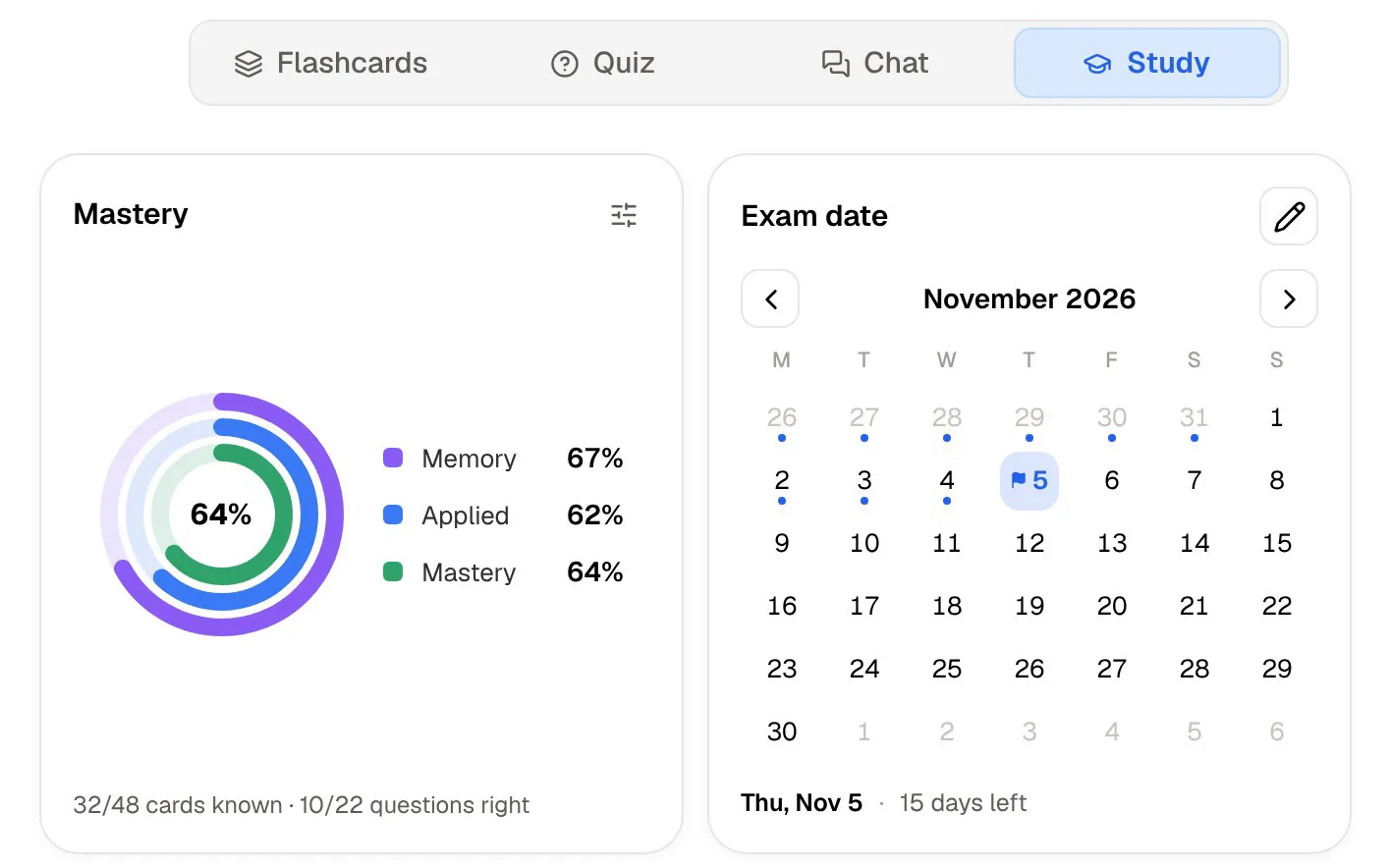
PocketNote has tools aimed at that second skill. The oral exam has Prof. Poki ask you questions out loud or in text and keep probing until you can explain the topic in your own words. You can also ask Poki for a comparison table from your notes, or generate a mind map that shows how the topics connect.
If your next test is mostly multiple choice on a fixed list, this matters less. If it has written answers, practising the explaining is worth the extra effort.
Where Blooket is the better choice
Blooket is the stronger pick in these situations, and in the first one PocketNote isn't an option at all.
- You're a teacher running a class game or setting gamified homework. PocketNote is not a classroom game host.
- You're reviewing a fixed list of terms or facts and a good public set already exists.
- Motivation is the problem. If you'd rather play than review, a game may get you through more questions than a deck you keep putting off.
- You want class reports. Blooket's reports, enhanced on Plus, show teachers how students did.
- You want a quick check, not a study session. A short solo round is a low-effort way to see whether a list has stuck.
A sensible way to use both
A practical split: let class games and the occasional solo round in Blooket handle fast, fun practice, and use PocketNote to learn the material those questions come from, so the game is checking knowledge you have actually built rather than standing in for it.
When a Blooket round shows you a weak spot, open the related handout or notes in PocketNote and work on that topic: a quiz with explanations, a few days of flashcards, and a question to Poki if something still doesn't make sense.
If you have a question set as text, you can paste it into PocketNote as a source and generate flashcards from it, though the original handout or chapter gives Poki more to work with.
A week before a test, it can help to swap the order: start in PocketNote to learn the material, then play a Blooket set at the end of the week as a quick check that it stuck.
The verdict
Which one should you pick?
Pick PocketNote if…
- You're studying alone from your own handouts, slides, lectures or notes.
- You want reviews on a schedule, with missed cards returning before you forget them.
- You need to explain answers, and want explained quizzes and an oral exam.
- You have a test date and want a plan with reminders.
Pick Blooket if…
- You're a teacher who wants live class games, homework with deadlines and reports.
- You're drilling a fixed list and a public set already covers it.
- You need a game to get started and the rewards keep you answering.
Try it yourself
See it with your own notes
PocketNote is a study app built on your own material. Import a PDF, a Word file, audio or a YouTube or web link, record a lecture, or write notes, and it makes flashcards with spaced repetition, quizzes that explain every answer, mind maps, audio reviews, an oral exam and a study plan up to your test date.
Poki answers from your files with citations, and your library syncs between pocketnote.app in the browser and the iPhone and iPad app. It's free to start.
Frequently asked questions
Sources
Keep reading