
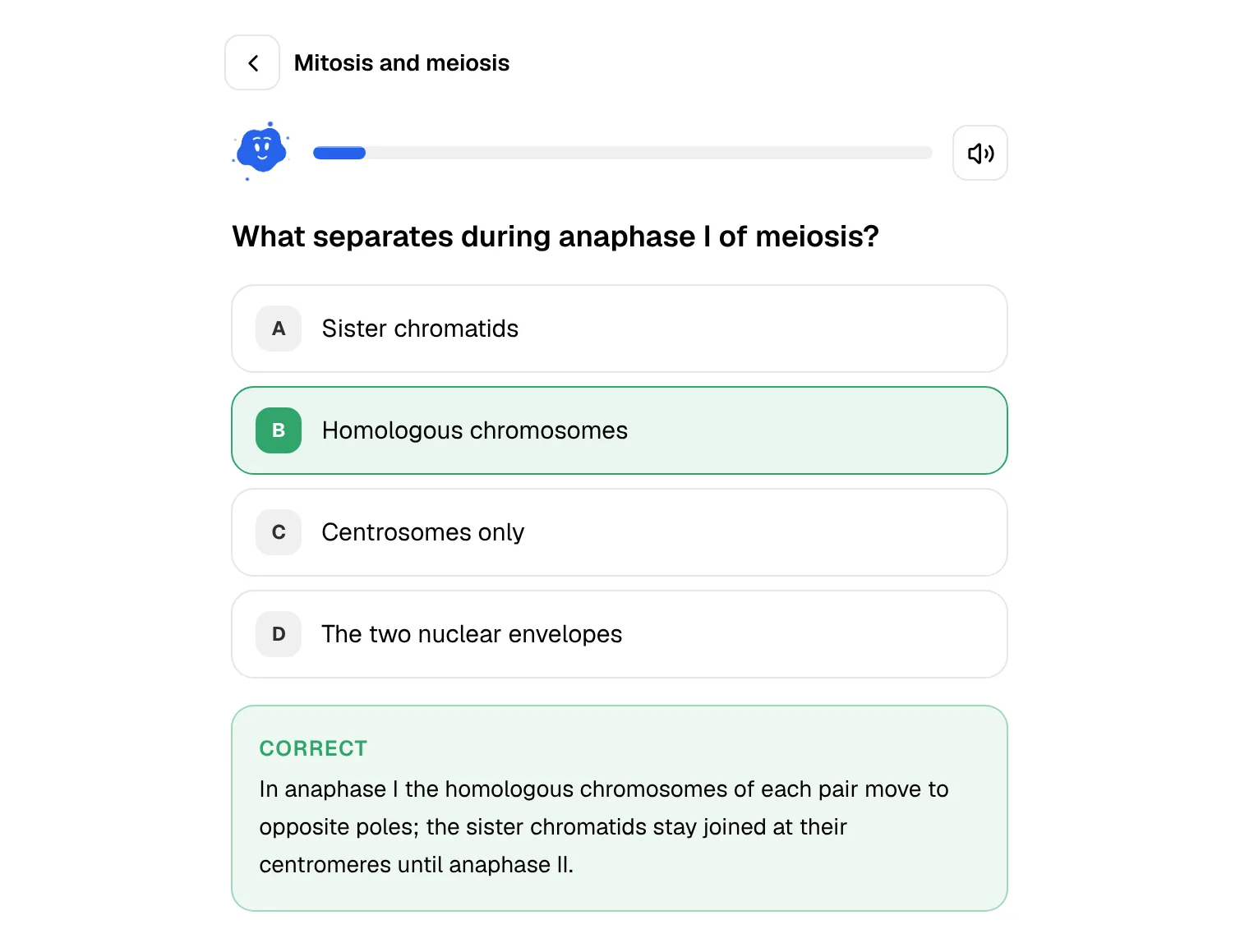
Kahoot! is the quiz game many students know from class: a host puts a question on the screen, everyone answers on their phones against the clock, and a leaderboard decides who wins. It is run by a teacher, presenter or friend, and it is very good at turning ten minutes of review into the liveliest part of a lesson.
PocketNote does a different job. It is a personal AI study app: you bring your own lectures, PDFs and notes, and Poki, its AI, turns them into flashcards with spaced repetition, quizzes that explain every answer, an oral exam and a study plan built around your exam date. PocketNote doesn't host live games for a class, and this post won't pretend it does.
Kahoot! also has a study side now, with flashcards, practice tests and AI that makes study sets from your notes. So the useful comparison is between Kahoot!'s student tools and PocketNote for self-study, with the class game as context. Details are as checked on Kahoot!'s own pages in November 2026.
At a glance
PocketNote vs Kahoot!
| Feature | PocketNote | Kahoot! |
|---|---|---|
| Who runs it | You, on your own material | Usually a host: a teacher, presenter or friend |
| Live hosted games | Not offered | Yes, its core feature, plus study groups |
| Where questions come from | Your PDFs, Word files, lectures, YouTube and notes | Topics, URLs, PDFs, scanned notes or a ready-made library |
| Flashcards | Spaced repetition: Again, Hard, Good, Easy | Flashcards and Learn mode; spaced repetition not advertised |
| Quiz style | Untimed, every option explained | Timed games, untimed Learn mode, practice tests |
| Lecture recording | Record, transcribe and summarise | Not advertised |
| Oral exam | Prof. Poki asks and follows up | Not advertised |
| Keeping you on track | Exam-date study plan with reminders | Weekly streaks and a study-time widget |
| Ready-made content | No public library of decks | Library of ready-made kahoots |
| Apps | Web, iPhone and iPad | Web, iOS, Android and more |
| Price model | Free to start; Basic and Plus plans | Free tier; paid Kahoot!+ plans |
Checked against each product's own website, November 2026. Plans and features change; confirm current details there.
Two different jobs: hosting a game and studying alone
A live kahoot is social and fast. A host runs it, everyone plays at once, questions are timed and correct answers score points, and the energy comes from competing in the room. That makes it excellent for a quick check of a class's understanding, a review lesson before a test, or a study night with friends.
Studying for an exam alone is slower and more private. You need to find what you don't know, test yourself on it repeatedly, and keep coming back to it over weeks. Speed and points matter less than spacing and explanations. PocketNote is built for that second job, and Kahoot!'s live games are built for the first.
Neither job is more important, and you probably need both: a quick, social check in class that shows where they stand, and steady private work between classes that closes the gaps. The mistake is expecting one tool to do both.
What Kahoot! does well, in class and in its study app
For teachers, Kahoot! is a complete toolkit. Plans run from a free tier to paid Kahoot!+ tiers with higher player limits, and an AI generator can build a kahoot from a topic, a web page, a Wikipedia article or an uploaded PDF, with page limits that rise with the plan. Teachers can assign kahoots as homework (on higher tiers, with no deadline so players go at their own pace), and reports show how the class did. A library of ready-made kahoots, browsable by subject, means nobody has to write every quiz from scratch.
For students, the Kahoot! app has study tools of its own. You can study flashcards; use Learn mode, which drops the timers, points and podiums of live games; take timed practice tests with a results summary; and challenge friends in study groups. Weekly streaks count the kahoots you play, a home-screen widget tracks your study time, and kahoots can be saved for offline study, which Kahoot! says is free for every student. You can also build presentations with interactive questions, which some students use for class projects.
Its AI builds study sets from your material too. Kahoot! says you can generate a quiz from a URL, a Wikipedia article, a PDF or your handwritten notes, which you scan with the app's camera, and its AI Notes feature turns notes into flashcards and practice questions. Kahoot! describes the basic experience as free to try and puts its best study tools in the paid Kahoot!+ plans. What its pages don't mention is spaced repetition: the flashcards and practice tests aren't described as scheduling reviews around when you are likely to forget.
What PocketNote does after the class game
Say your teacher ran a kahoot on cell division and you got four of ten wrong. That is useful information, but the game is over. In PocketNote you take it from there with your own material: import the lecture slides as a PDF, add the lecture recording (or record the next one in the app and get a transcript, a summary and notes), and paste the YouTube video your teacher recommended, which brings its transcript with it.
Ask Poki about the parts you got wrong. It answers from your material with citations, so you are reading your course's explanation rather than something from the open web. Then generate a quiz on the same topic. Unlike a timed game, every question comes with an explanation of why the right answer is right and why each wrong option is wrong, and there is no clock pushing you to guess.
If you would rather see the whole topic before drilling it, generate a mind map, written notes or a slide deck from the same lecture. Everything stays in the notebook, so next week's questions on the topic can draw on all of it. For language courses, PocketNote can produce study material in more than 50 languages, including from a source written in another one.
Speed vs spacing: two kinds of practice
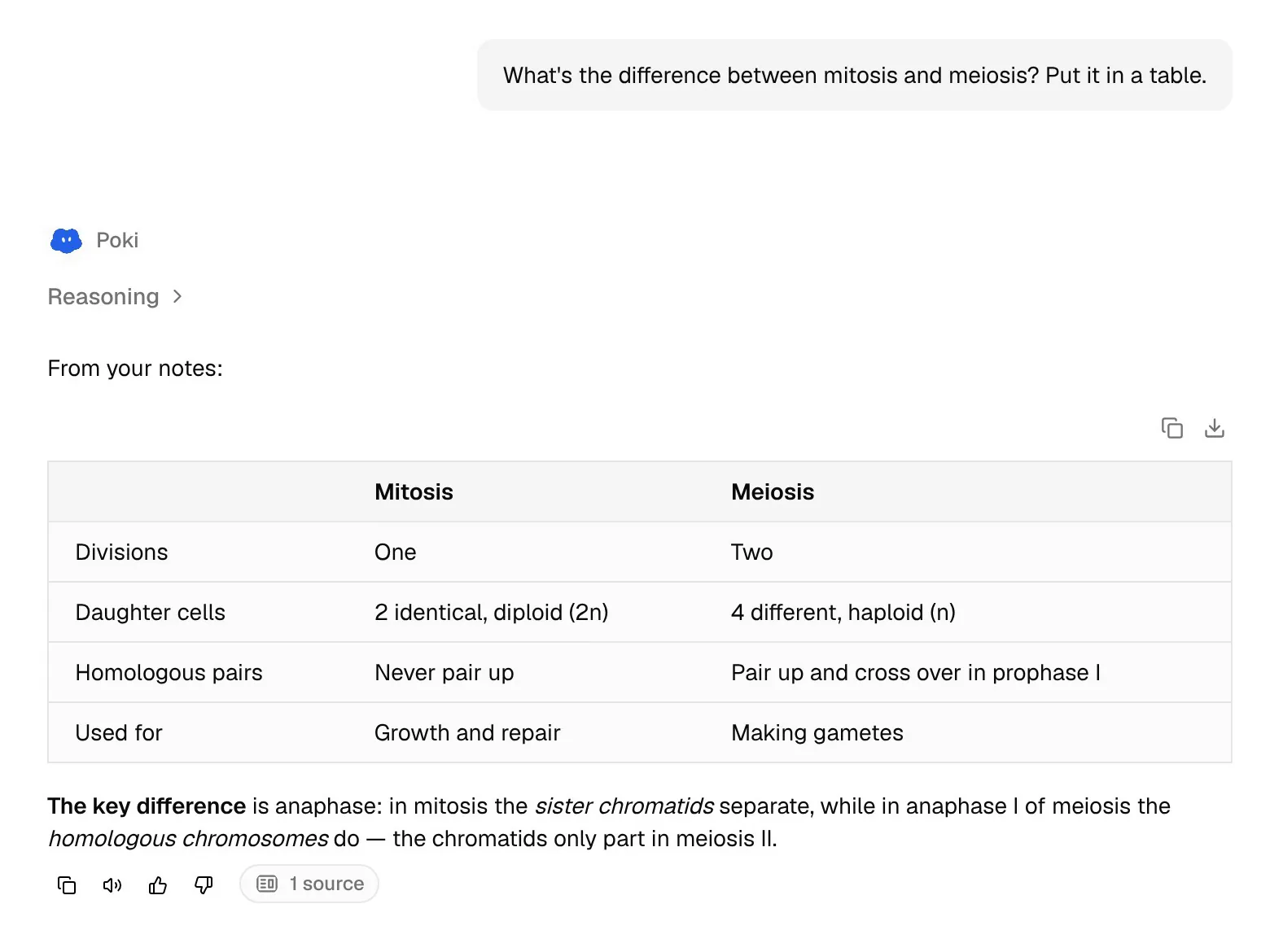
Both apps rely on retrieval practice, answering questions instead of rereading, which is one of the best-established ways to learn. They differ in how they time it. A live kahoot tests a class once, right now. PocketNote's flashcards use spaced repetition: rate each card Again, Hard, Good or Easy, and each comes back at the point you are about to forget it, so reviews spread further apart as you learn.
Set an exam date and the study plan takes this further. It decides what to cover each day, reminds you, and tracks memory, applied and mastery scores across flashcards, quizzes and the oral exam, so you can see which topics are still weak a week before the test.
Over a term, the difference adds up. A set of kahoots played in class gives you a series of one-off snapshots. A PocketNote deck reviewed on schedule since week 2 means each card has been tested several times, spread over weeks, by the time the exam arrives.
Kahoot!'s streaks reward studying regularly, which helps habits. PocketNote's schedule decides what to study, which helps memory. There is room for both nudges.
Explaining, not just picking an answer
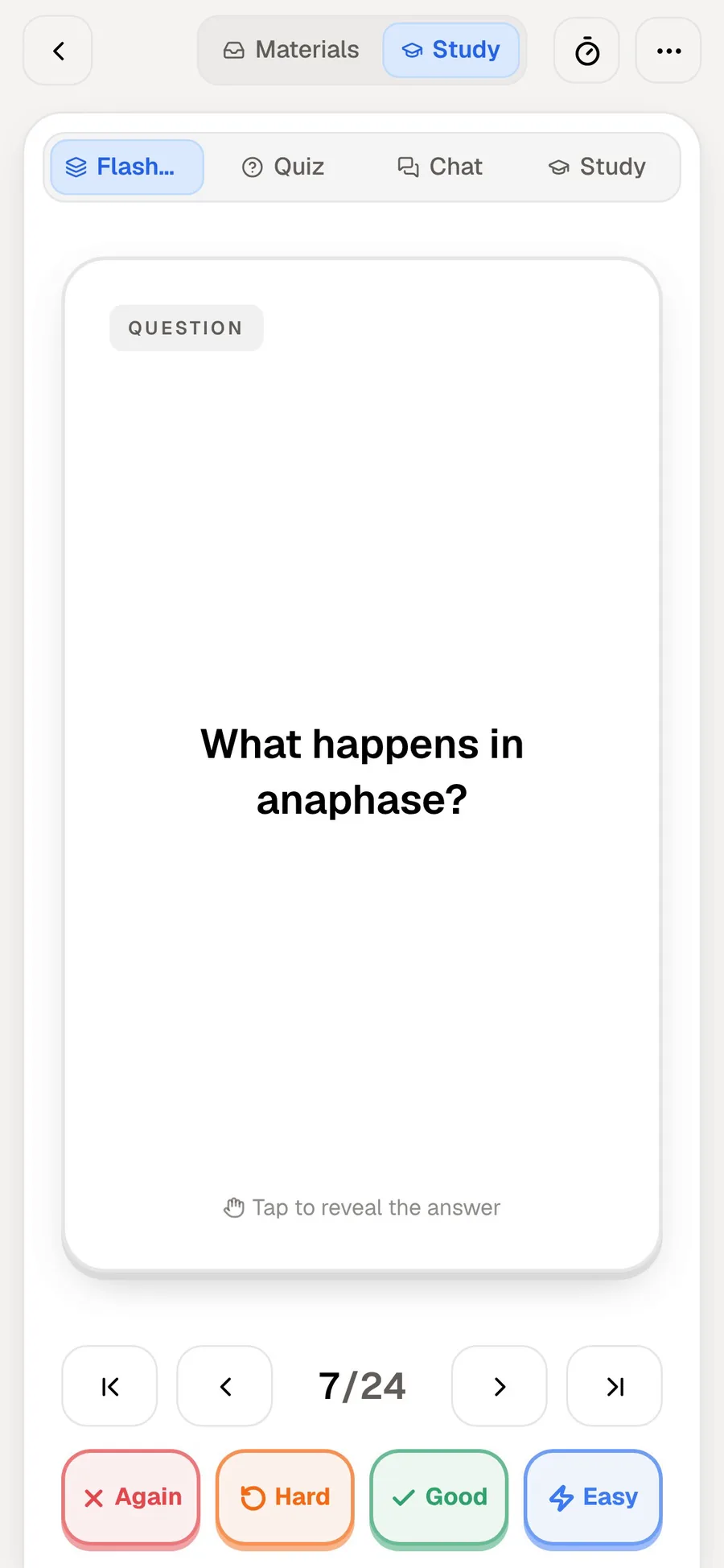
Multiple-choice questions test recognition: you see the right answer among the options and pick it. Exams, especially written and oral ones, often ask you to produce the answer and explain it. PocketNote's oral exam practises that. Prof. Poki asks you a question out loud or in text, listens to your answer in your own words, and keeps probing until you can explain the topic.
This matters most in subjects marked on explanation: an essay question in history, a mechanism in biology, a derivation in physics. Picking the right option under time pressure is a different skill from writing three clear paragraphs on why it is right, and it is worth practising the second one before the exam asks for it.
On paid plans you can also talk to Poki with live voice and be quizzed out loud while you walk, or listen to an audio review of your material on the way to class, a podcast-style episode with captions that follow the voices.
Prices and plans
Kahoot! has a free tier and paid Kahoot!+ plans for teachers and for students, in tiers such as Bronze, Silver and Gold, with higher tiers adding larger player limits and more AI generation; schools can also buy Kahoot! EDU. Kahoot!'s pages showed promotional and differing prices when we checked in November 2026, so confirm the current price at checkout.
For a student, the real question is whether you need Kahoot!+'s AI study tools at all, or whether your teacher's games plus the free tier cover what you want from Kahoot!. If your own revision is the bigger job, that is the part to spend on.
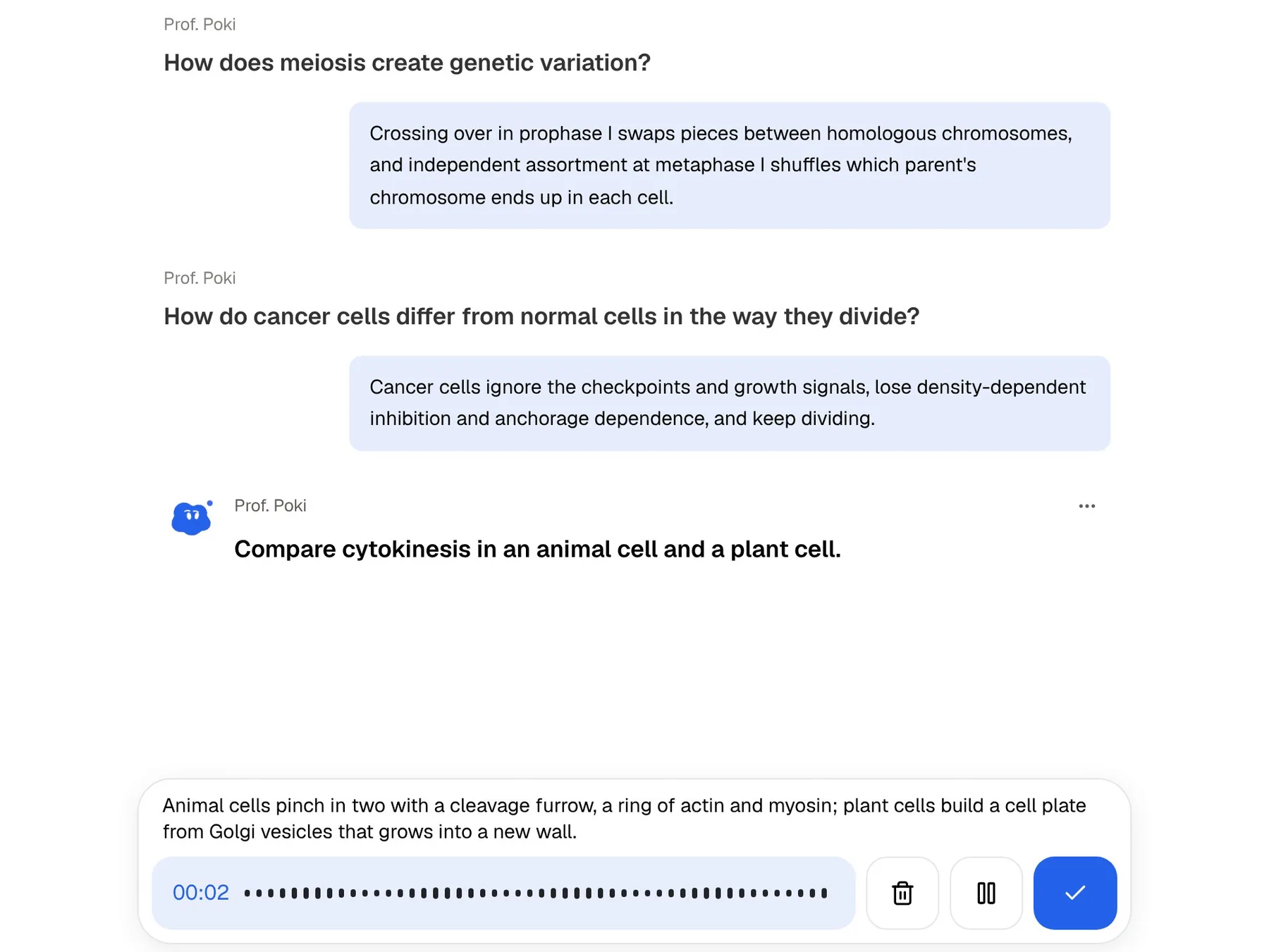
PocketNote is free to start, with paid Basic and Plus plans; Basic adds live voice, premium AI models and connectors, and Plus adds unlimited notebooks and apps and all models. See pocketnote.app for current plans.
Where Kahoot! is the better choice
Kahoot! is the right tool, and PocketNote isn't, when:
- You are running or playing a live class game. Hosting timed, scored quizzes for a room is Kahoot!'s core, and PocketNote doesn't do it.
- You want to study competitively with friends. Study groups and live games make revision social.
- You want ready-made quizzes on common topics. Kahoot! has a library to browse; PocketNote has no public library of other students' decks.
- You are a teacher. Assignments, reports and an AI generator for class quizzes are built for you.
- You study on Android. The Kahoot! app is on Google Play as well as the App Store.
Using both in the same term
The two fit together naturally. Play the kahoot in class and notice what you got wrong. Take those topics into PocketNote, where your own lecture and notes become flashcards on a schedule, a quiz with explanations and a plan that runs until the exam.
If your teacher shares the kahoot's topic list or the slides behind it as a PDF, import those too, so your flashcards cover exactly what the class was tested on.
For group revision, Kahoot! is the better host. One person runs a kahoot on the week's topics, everyone plays, and each person takes their own misses into PocketNote afterwards, where the follow-up is private and paced to them.
The verdict
Which one should you pick?
Pick PocketNote if…
- You are studying on your own for an exam, from your own lectures, PDFs and notes.
- You want flashcards with spaced repetition and a plan built from your exam date.
- You want every quiz answer explained, without a timer.
- You want to practise explaining topics out loud in an oral exam.
Pick Kahoot! if…
- You are hosting or playing a live quiz game in class or with friends.
- You want ready-made quizzes and competitive study groups.
- You are a teacher who needs assignments, reports and class-sized player limits.
Try it yourself
See it with your own notes
PocketNote is a personal AI study app for the web, iPhone and iPad. Import PDFs, Word files, audio, YouTube or web links, record a lecture or write notes by hand, and Poki turns them into flashcards with spaced repetition, quizzes with explanations, an oral exam, mind maps and audio reviews, with an exam-date study plan to keep you on track.
It doesn't host class games. It is free to start, and it is a good place to work on the questions you missed in a kahoot.
Frequently asked questions
Sources
Keep reading