
If you remember Shiken as an AI quiz and flashcard app for students, its website will surprise you. In November 2026 Shiken describes itself first as a sales enablement and people-performance platform: a meeting recorder, AI roleplay with scored coaching, a content studio and a learning platform for teams. Students and individual learners are still served, through a Learner track with AI flashcards, quizzes and spaced repetition, but they are no longer the headline.
That shift is the most useful thing to know before comparing it with PocketNote. Both can turn your documents into flashcards and quizzes, and both can answer questions with citations. They differ in who the product is built around: Shiken around people improving at work (with learners alongside), PocketNote around a student with a syllabus, a pile of lecture material and an exam date.
This comparison covers Shiken's learner features and plans as described on its own site and pricing page in November 2026, what PocketNote does with the same material, and the cases where Shiken is the better fit.
At a glance
PocketNote vs Shiken
| Feature | PocketNote | Shiken |
|---|---|---|
| Built mainly for | Students studying their course material | Sales and L&D teams; Learner track for individuals |
| Flashcards | Yes, with spaced repetition | Yes, with spaced repetition |
| Quizzes | Generated from your material, every option explained | Multiple choice, true/false, open-ended |
| What you can add | Files, audio, YouTube, web links, Drive, OneDrive, Dropbox | Docs, PDFs, YouTube, web links, recordings, a topic name |
| Recording | Lecture recording with transcript and notes | Meeting recorder, with or without a bot |
| Answers with citations | Yes, Poki cites your sources | Yes, via Shiken Agents |
| Speaking practice | Prof. Poki oral exam; live voice on paid plans | AI roleplay with scored feedback |
| Handwriting and PDF annotation | Yes | Not advertised |
| Study planning | Plan from your exam date, reminders, mastery scores | AI study plans, goals, streaks, learning paths |
| Languages | Study material in 50+ languages | 40+ languages for content and roleplay |
| Free plan | Free to start | Free forever, small lifetime caps |
| Paid plan for one learner | Basic or Plus (see pocketnote.app) | Learner Plus: $25/mo or $10/mo yearly |
Checked against each product's own website and Shiken's published pricing, November 2026. Plans and features change; confirm current details there.
What Shiken is today
Shiken's homepage now opens with AI coaching, roleplay and meeting notes for work. Its summary page describes a meeting recorder that works online or in person, AI scoring and coaching against sales or leadership frameworks, roleplay practice built from real calls, a content studio for courses and microlearning, and integrations with tools such as Salesforce, HubSpot, Zoom, Teams and Slack. Its pricing is split into three tracks: Learner, Creator and Enterprise.
The Learner track is where students fit. Shiken's learner page promises AI flashcards from your notes, PDFs or just a topic name, practice quizzes with multiple-choice, true/false and open-ended questions, structured courses, study goals and streaks, AI study buddies, leaderboards, and a spaced-repetition algorithm that schedules reviews. It also lists an AI knowledge agent that answers questions about your material.
So Shiken has not stopped serving learners. But a student evaluating it should know that many of the features on the homepage (CRM sync, manager scorecards, SCORM export) are for companies, and that the free Learner plan is described as a meeting recorder first.
What Shiken's learner side does well
The quiz variety is a genuine strength. Open-ended questions make you produce an answer rather than recognize one, and true/false questions are quick to get through on a phone. Combined with spaced repetition and daily goals, that covers the core of active recall.
Spoken practice is Shiken's other distinctive feature. Its AI roleplay lets you rehearse conversations with lifelike characters and get scored feedback, in more than 40 languages. For a language learner, or a student preparing for interviews, placements or clinical conversations, that goes well beyond what a flashcard app offers.
Finally, it spans school and work. If you are a working professional taking a course, or a graduate student who also has meetings to record, one tool that records the meeting, summarizes it and turns it into practice material is convenient.
It can also start from nothing. Shiken says it can generate flashcards from just a topic name, and its learner side offers structured courses and learning paths that mix courses, slides and video, with a short daily practice row. That suits picking up a new subject on your own time, where there is no syllabus to follow.
Where it fits a student less neatly
The free plan is built for trying the meeting recorder. At the time of writing (November 2026) it includes unlimited meeting recording and transcripts with a 30-day history, 5 AI meeting summaries a month, 10 roleplay turns and 5 own-use creations over the life of the account. Five creations is enough to judge the flashcards and quizzes, but not to study a course with.
The paid Learner Plus plan is where flashcards and quizzes become unlimited, and its feature list mixes study and work: 20 meetings a month with full AI, coaching feedback and delivery analytics, 500 AI chats a month, unlimited AI notes, 50 roleplay turns a month, unlimited personal courses, quizzes and flashcards, and calendar auto-join. A student pays for the meeting features whether or not they use them.
Generating from a topic name is convenient, but it carries a risk for exam preparation: the AI decides what the topic includes, and that may not match what your lecturer covered or how your exam is marked. Shiken also accepts uploaded documents, and for a taught course that is the better habit in any app, because practice built from the lecturer's own slides stays aligned with what will be examined.
Shiken does not advertise handwritten notes or writing on PDFs. Its learner page mentions AI-generated study plans alongside goals, streaks and learning paths, which keep you consistent; it does not describe a plan that counts down to a specific exam date.
A week of exam revision in PocketNote
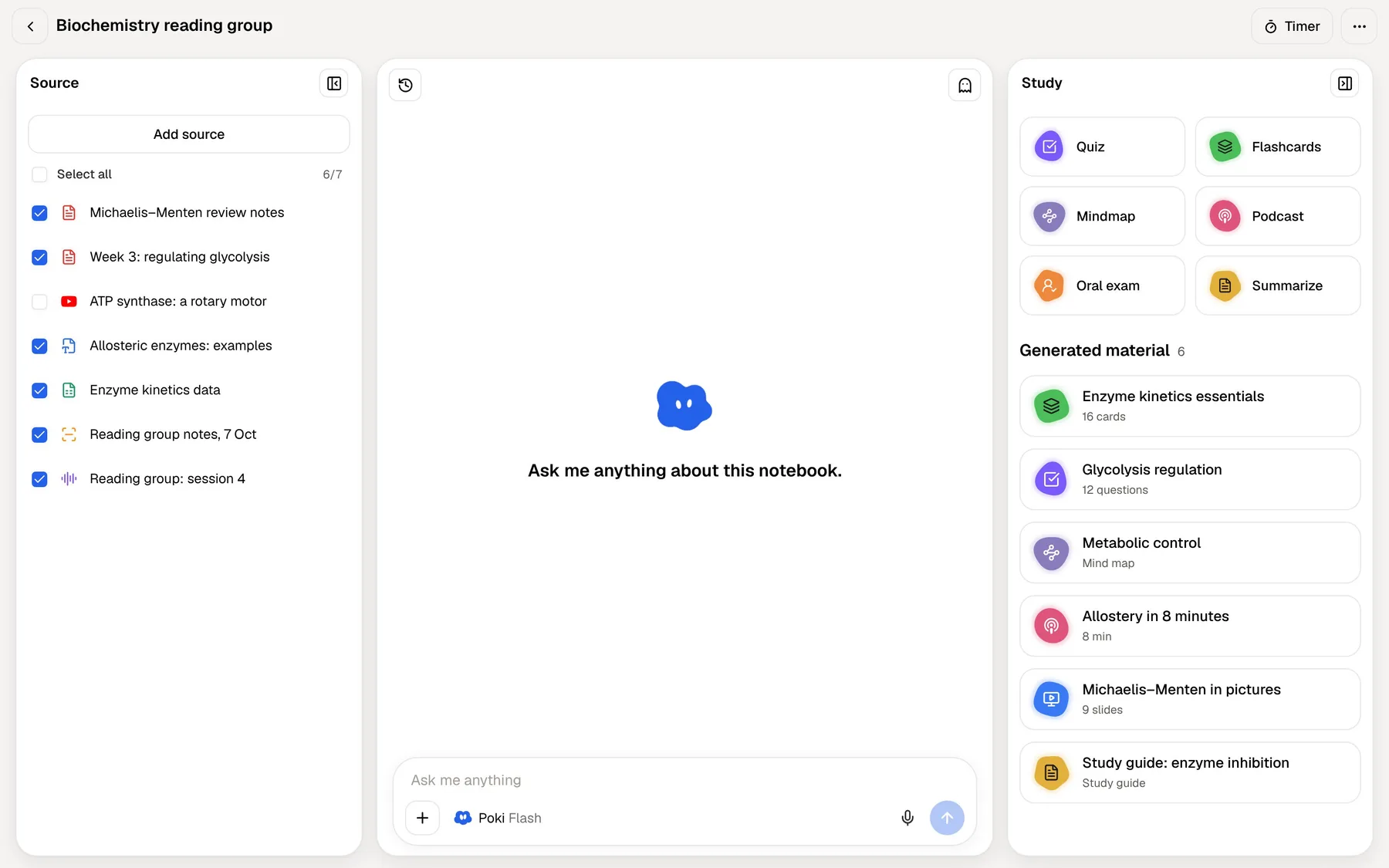
Getting the material in comes first. You import the lecture PDFs, Word handouts and reading list, paste YouTube links for recorded lectures, pull files from Google Drive, OneDrive or Dropbox, or record a review session in the app. Everything for the course sits in color-coded folders, so the plan and every study tool draw on the same sources.
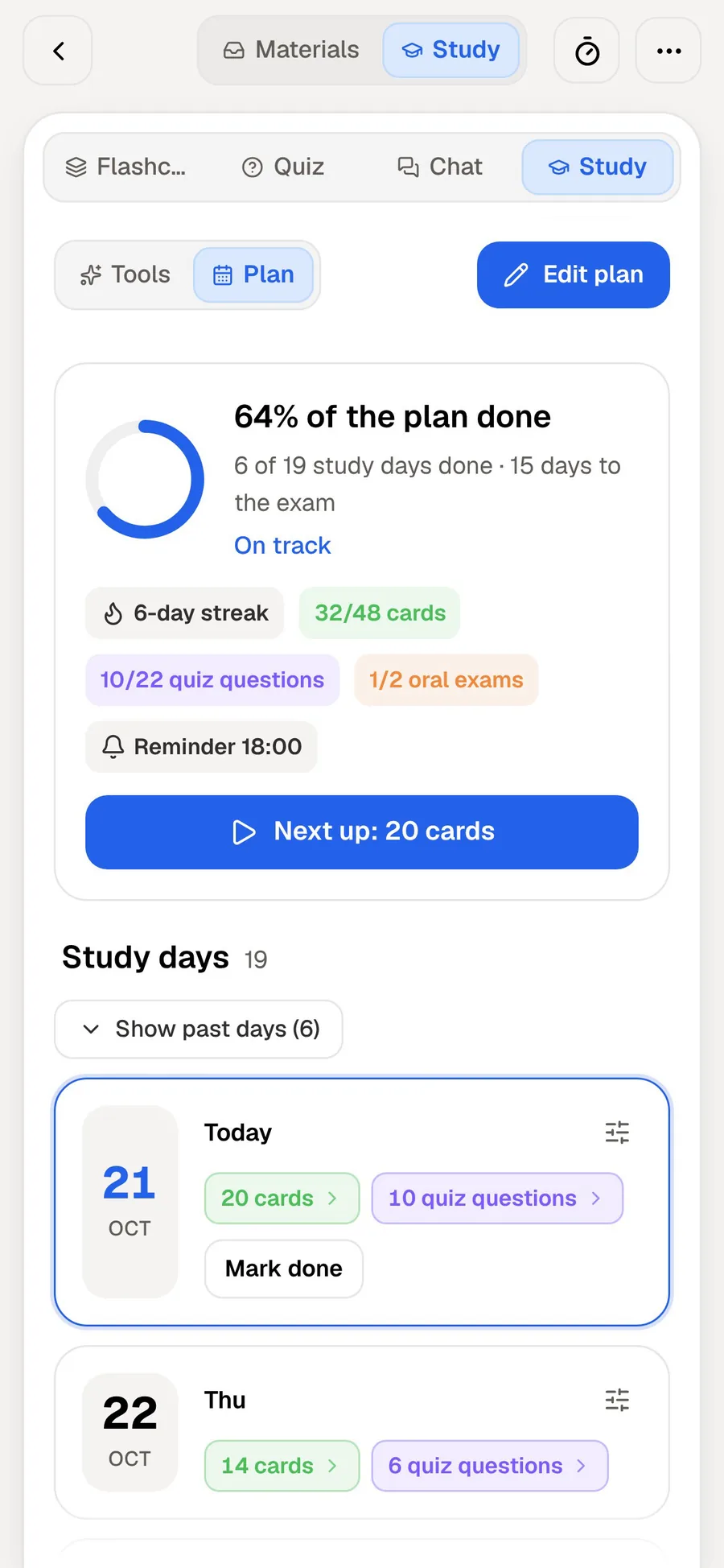
Here is how the week before a biology exam then looks. You set the exam date in a study plan. PocketNote divides the material across the days you have, reminds you each day, and tracks memory, applied and mastery scores so you can see which topics are solid and which are not.
Each day's work comes from your own course material. Flashcards return on a spaced-repetition schedule after you rate them Again, Hard, Good or Easy. Quizzes explain every option, right and wrong. When you hit a topic you cannot explain, you ask Poki, and it answers from the lecture notes and slides you imported, with citations you can open.
On the last two days you switch to the oral exam: Prof. Poki asks questions out loud or in text and keeps following up until your explanation holds together. That is the closest thing to a tutor checking whether you understand the material rather than recognize it.
Speaking practice: roleplay versus oral exam
Both products believe in practising out loud, but they aim at different conversations. Shiken's roleplay casts an AI character (a stakeholder, a manager, a clinician, a customer) and scores how you handle the conversation against a rubric. It rehearses a performance.
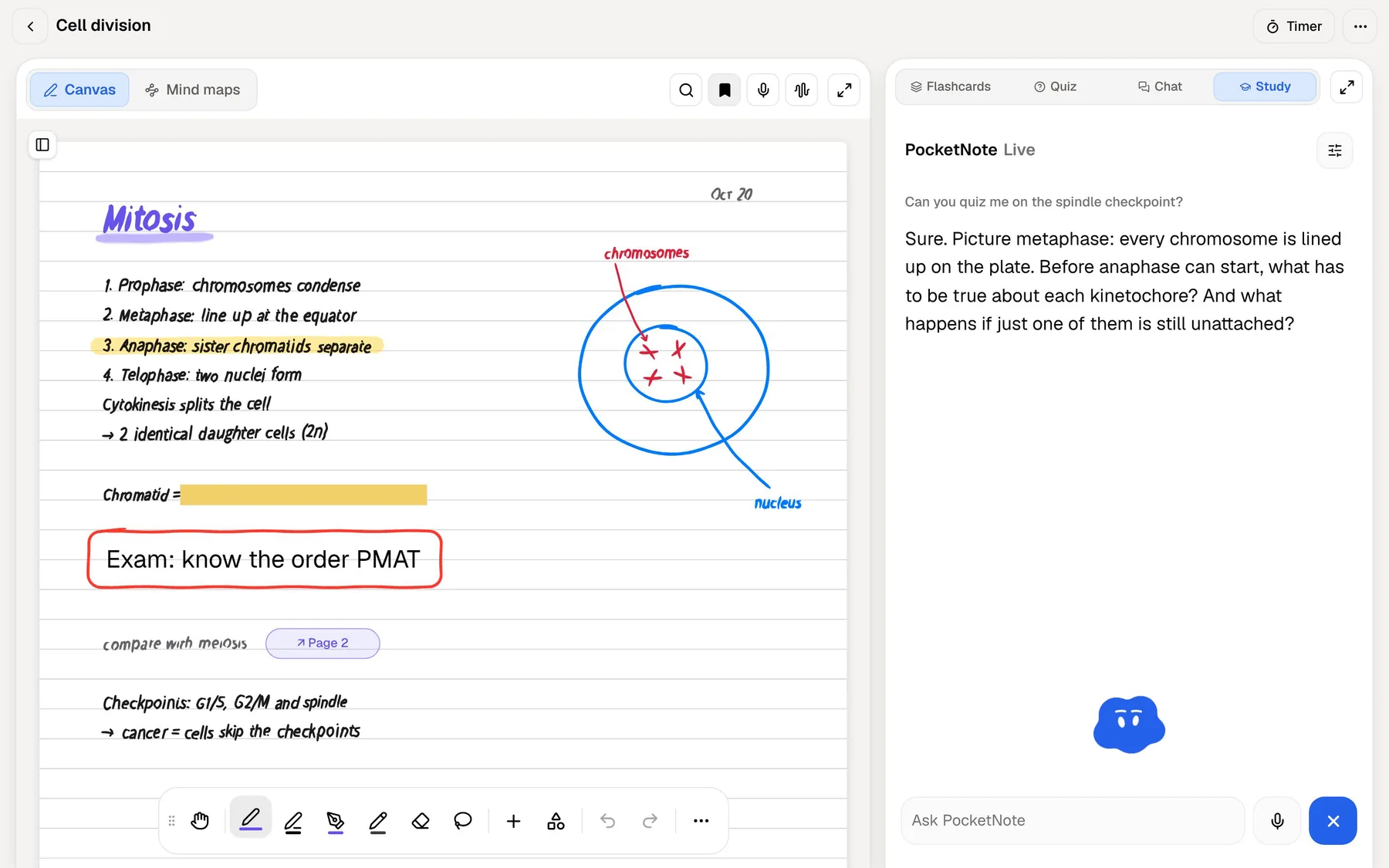
PocketNote's spoken tools rehearse knowledge. In the oral exam, Prof. Poki questions you about your course material and probes weak answers. With live voice on paid plans, you can ask Poki to quiz you out loud on a topic, such as the spindle checkpoint, and answer by speaking. If your goal is an exam, a viva or a seminar, that is the closer match. If your goal is a sales call or a language conversation, Shiken's roleplay is.
Answers you can check
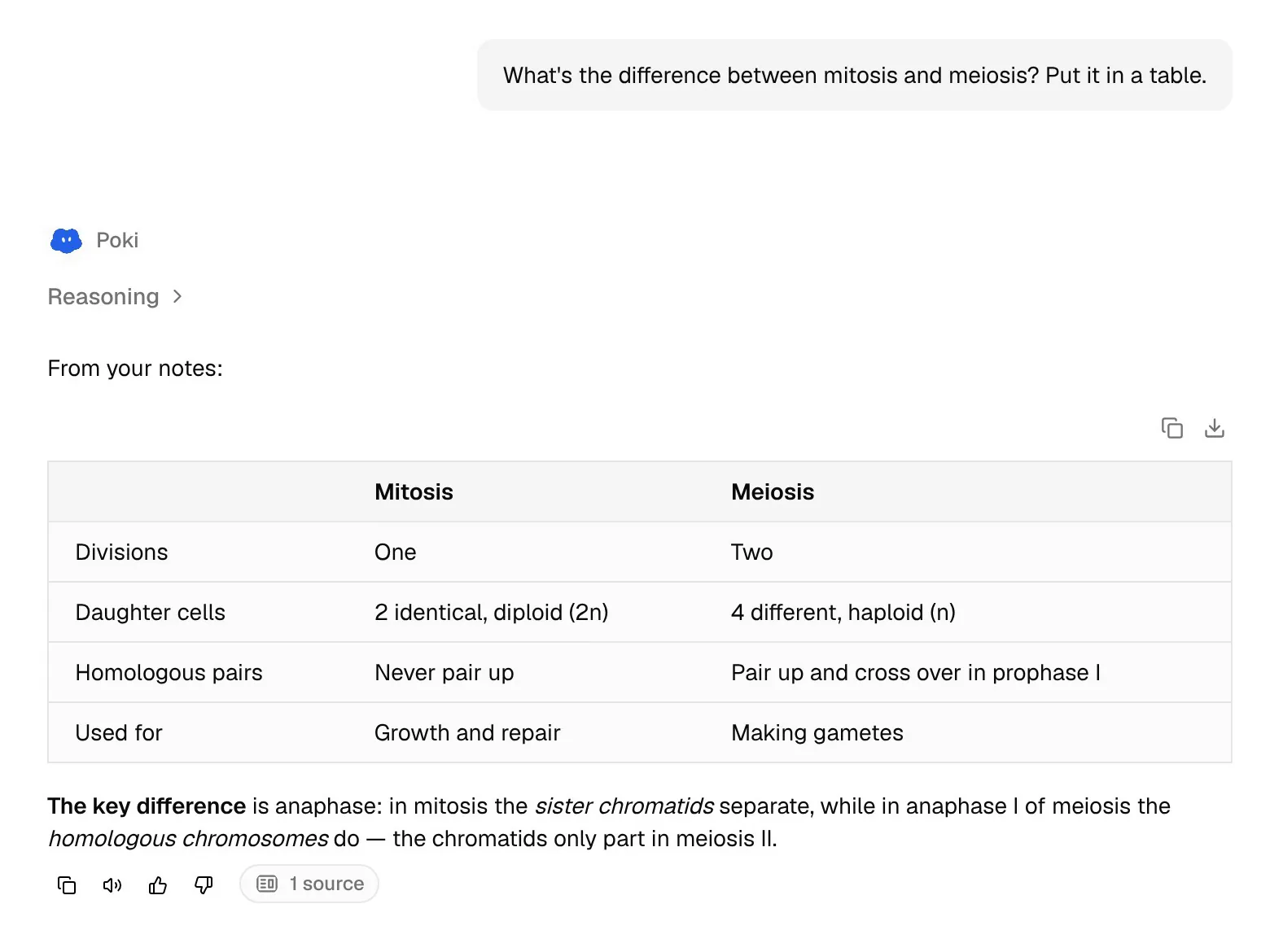
Shiken Agents build a knowledge base from your documents, videos and links, and Shiken says they answer questions across your meetings and sources with citations. PocketNote's Poki works the same way on your study library: it answers from your own material instead of the open web and shows the sources it used.
PocketNote also shows its steps as it works (searching your notes, reading a specific item, starting a quiz), and it can look at a PDF page as you see it, including your own highlights and handwriting. For a student, that means a question about a diagram you annotated in the margin gets an answer about that page, not a generic one. In both apps, answers are only as good as the sources behind them, so add your lecturer's own material first.
Pricing side by side
Shiken publishes its prices. At the time of writing (November 2026), Learner Plus costs $25 a month, or the equivalent of $10 a month billed annually. Learner Pro, described as for educators and teams, costs $50 a month, or $30 a month billed annually. Creator plans for selling courses start at $149 a month ($124 a month billed annually), and Enterprise is quoted per seat. Prices are also listed in pounds and euros.
PocketNote is free to start. Its paid plans are Basic (live voice, premium AI models and connectors) and Plus (unlimited notebooks and apps, the longest podcasts and all models). See pocketnote.app for current prices.
When you compare, compare like with like. A student who only needs flashcards, quizzes and a plan should weigh what each paid plan adds for studying, and ignore the meeting minutes, roleplay turns or connectors they will never use. Both have free starting points, so the cheapest test is one real course in each before paying for either.
Where Shiken is the better choice
Shiken is the stronger pick when your learning is tied to work or to speaking.
- You want to rehearse conversations. Scored AI roleplay for interviews, sales calls, clinical or customer conversations has no equivalent in PocketNote.
- You are learning a language. Roleplay and tutoring in 40+ languages give you speaking practice, not just vocabulary cards.
- You also record work meetings. The Learner plans include a meeting recorder with calendar auto-join and AI summaries.
- You teach, coach or sell courses. Creator plans add course publishing, communities, live quizzes for groups and payouts.
- You like streaks and leaderboards. Shiken's learner side leans on goals, streaks and gamified practice.
The verdict
Which one should you pick?
Pick PocketNote if…
- You are a student with an exam date and want a plan, reminders and mastery tracking built around it.
- Your material includes lectures, slide PDFs and handwritten notes, and you want all of it in one library.
- You want an oral exam that tests whether you can explain your course content, not a scored roleplay.
- You would rather not pay for meeting and coaching features you will not use.
Pick Shiken if…
- You learn for work and also need a meeting recorder, coaching feedback or CRM-linked tools.
- You want AI roleplay for interviews, sales, clinical or language practice.
- You are an educator or creator who wants to build and share courses and live quizzes.
Try it yourself
See it with your own notes
PocketNote is an AI study app for the web, iPhone and iPad, built for students working through their own course material. Import files, recordings, YouTube and web links, or write notes by hand or keyboard, and generate flashcards with spaced repetition, quizzes that explain every answer, oral exams, audio reviews and a study plan tied to your exam date. Poki answers from your material with citations.
If you came looking for the student app Shiken used to put first, PocketNote is worth a try on one course. It is free to start.
Frequently asked questions
Sources
Keep reading