
AI Essay Writer
Type your topic or the assignment question, add your own notes if you have them, and pick the essay type, length and level. The AI writes a first draft with a title, an introduction that ends in a thesis, body paragraphs with topic sentences and a conclusion. It doesn't invent sources: where a claim needs evidence, it leaves a reminder for you to fill in.
- No account needed
- 5 free AI runs a day
- Your text isn't saved
How it works
- 01
Type your topic
Enter the topic or paste the assignment question, up to 800 characters. Add your own points, quotes and sources in the notes box, up to 6,000 characters, and the draft will use them.
- 02
Choose type, length and level
Pick one of six essay types, from argumentative to narrative. Choose a length of about 300, 500 or 800 words. Set high school or college level and the output language.
- 03
Revise it and make it yours
Check the draft against your assignment, replace the bracketed reminders with real sources and rewrite it in your own words. Copy it, download it as Markdown, print it, or send it to the grammar checker.
Using a draft
A draft is where the essay starts
A first draft gives you something to work on, which is easier than a blank page. The draft here follows the structure most essays are marked on: an introduction that ends in a thesis, body paragraphs that each open with a topic sentence, and a conclusion that does more than repeat the introduction. Read it with the assignment brief next to you. Check that the thesis answers the question that was actually asked, that every paragraph supports it, and that the order makes sense. Cut any paragraph that doesn't earn its place. Then rewrite it in your own words, with your own examples and the terms your course uses. That part is what gets graded.
The essay writer is told never to make up quotations, statistics or sources. Where a claim needs evidence it wasn't given, it leaves a bracketed reminder such as [add a source for this figure]. Treat each one as a to-do, and don't hand in an essay that still has brackets in it. You get a better draft if you supply the evidence first: paste your quotes, page numbers and sources into the notes box and the essay is built around them. Either way, check every fact against your reading before you submit, because an AI can state something confidently and still be wrong. When your sources are in, the free citation generator formats the references.
The essay type changes the draft more than the length does. An argumentative essay takes one position and answers the strongest counterargument in a paragraph of its own. An expository essay explains without taking a side. An analytical essay interprets how something works or what it means. Compare and contrast weighs two subjects point by point, and a narrative essay tells one story in the first person. If you aren't sure which one your assignment wants, look at the verb in the question: “argue” and “evaluate” ask for a position, “explain” doesn't. For a plan before the prose, start with the thesis statement generator and the essay outline generator, which can send its outline here.
The draft is not a finished assignment. Many schools and courses have rules on AI use; some allow it for brainstorming and drafting if you say so, and some don't allow it at all. Check yours before you use any of the text. The tool knows only your topic, the notes you paste and general knowledge, so it hasn't read your course readings unless you include them. Your topic and notes are sent to the AI to write the draft and aren't saved to an account or a database. In PocketNote, a course's lectures, PDFs and notes sit in one notebook: you can chat across all of them to find the evidence for an essay, and make flashcards, quizzes and study guides from the same material.
FAQ
Questions, answered
More free tools
AI writing tools
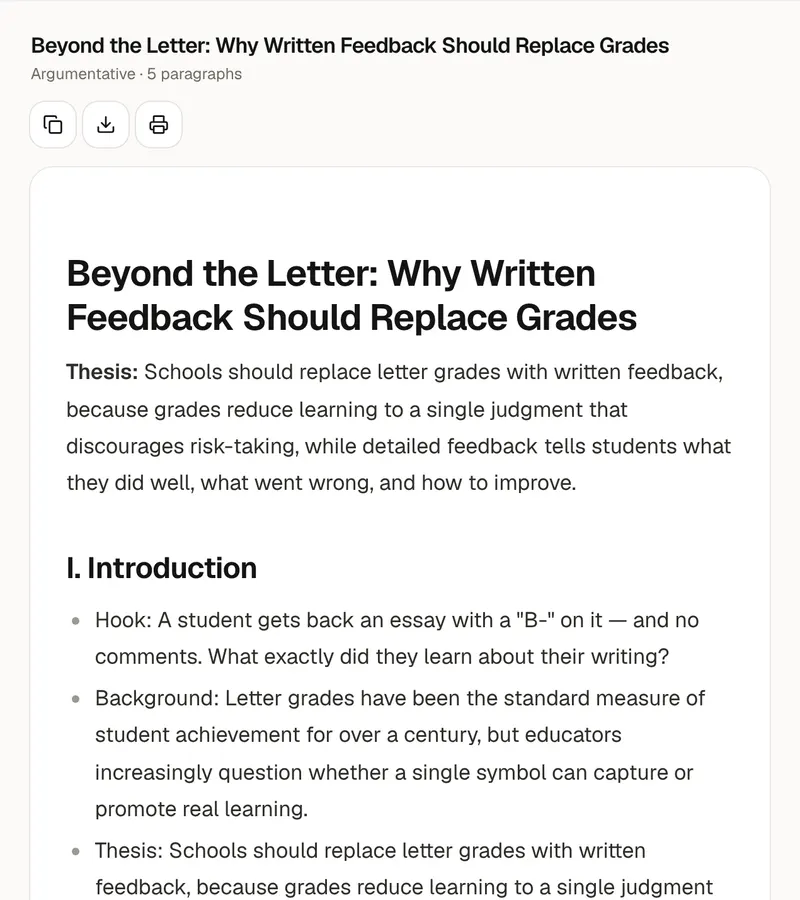
Essay Outline Generator
A topic in, a paragraph-by-paragraph plan out.
AI writing tools
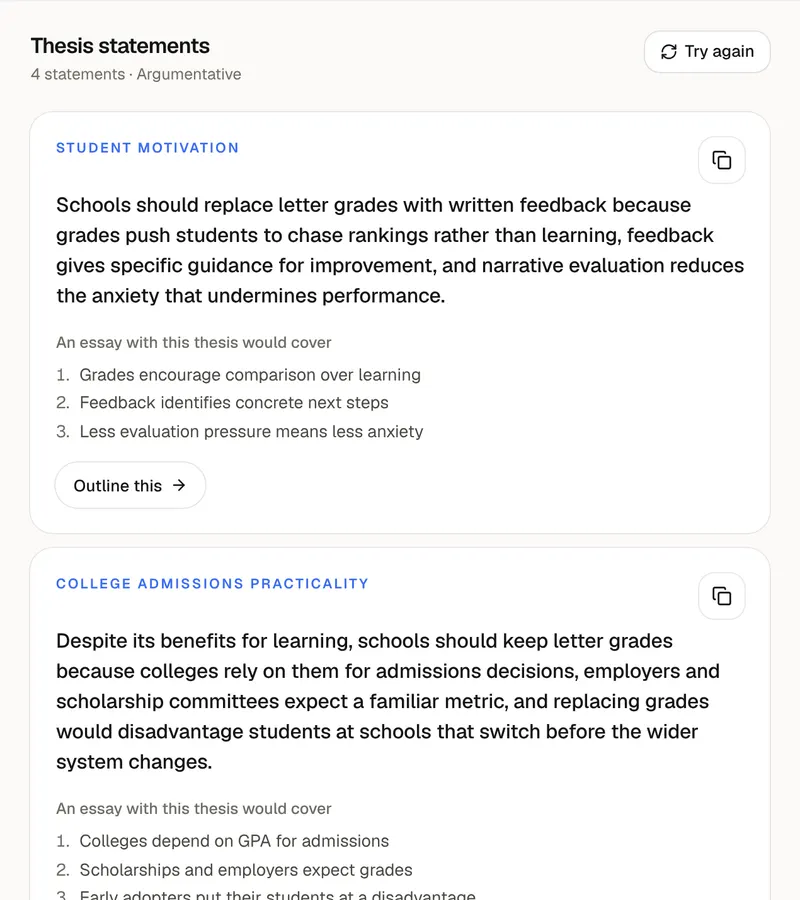
Thesis Statement Generator
Four thesis statements for your topic, each with its points.
AI writing tools
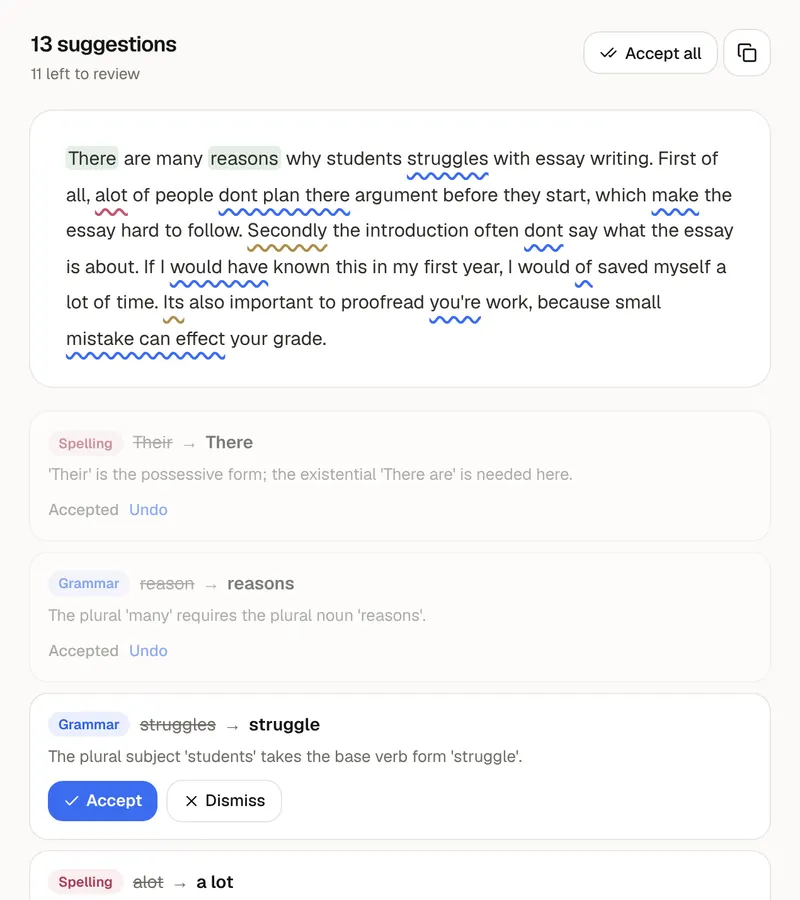
Grammar Checker
Every mistake underlined, with the fix and the reason.
Write from your own sources
PocketNote keeps a course's lectures, PDFs and notes in one notebook and answers questions across all of them.