
Thesis Statement Generator
Type your topic or the essay question and choose the kind of thesis you need. The AI writes four thesis statements, each from a different angle, with a short label for the angle and the three points an essay would develop. Pick one, copy it, or send it to the outline generator.
- No account needed
- 5 free AI runs a day
- Your text isn't saved
How it works
- 01
Type your topic or question
Enter the topic or paste the essay question. If you already have a position or main points, add them: every thesis will keep your position.
- 02
Choose the kind of thesis
Pick argumentative, analytical, expository, or compare and contrast, and the output language. Each run gives you four statements from different angles.
- 03
Pick one and build on it
Copy the thesis you can support best, or press “Outline this” to send it to the essay outline generator. Running the tool again gives you four new ones.
Writing a thesis
A strong thesis is one you could argue against
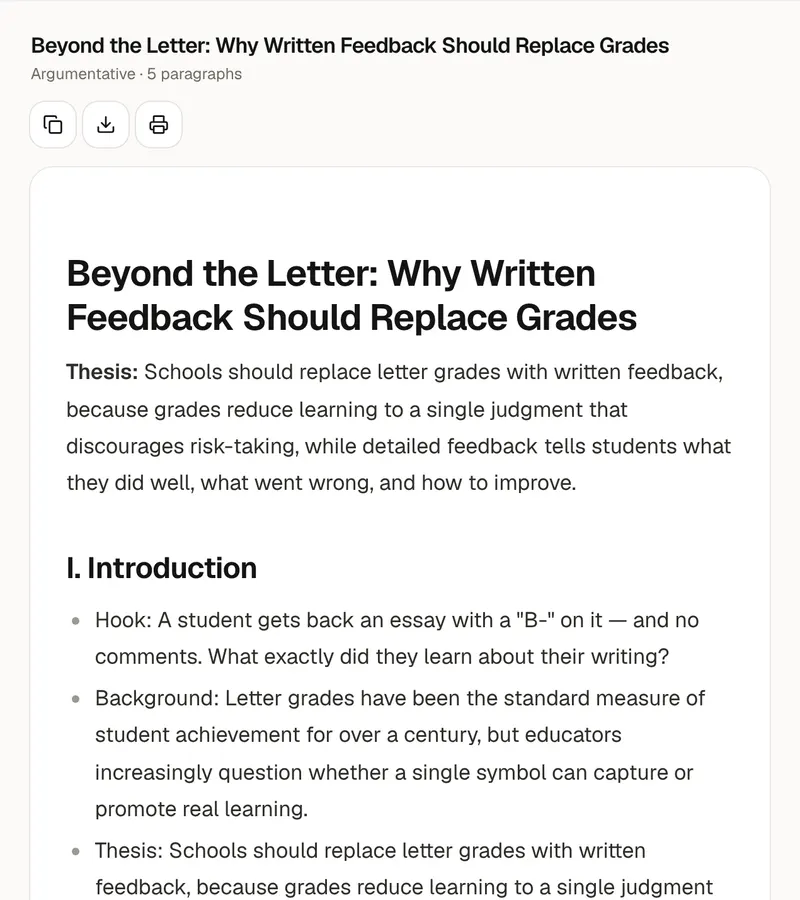
A thesis statement is the one or two sentences your whole essay sets out to support. A strong one is specific, narrow enough to defend in the space you have, and answers the question that was asked. For an argumentative essay it also has to be arguable. “Social media affects teenagers” is a fact nobody would dispute, so there is nothing to prove. “Schools should teach students how recommendation algorithms work, because knowing how a feed is built changes how teenagers use it” takes a side a reasonable person could reject. A thesis makes its claim directly. It doesn't announce (“In this essay I will discuss…”) and it isn't a question.
You get four statements because the first thesis you think of is rarely the best one. Each takes a different angle, named in a short label, and lists the three points an essay with that thesis would develop. Don't pick the one that sounds most impressive. Pick the one you can support with evidence you actually have. Go through its three points and ask what you would cite for each: a reading, a case, a data set, a passage from the text. If you can't think of anything for one of them, change that point or choose another thesis. Those three points become your body sections.
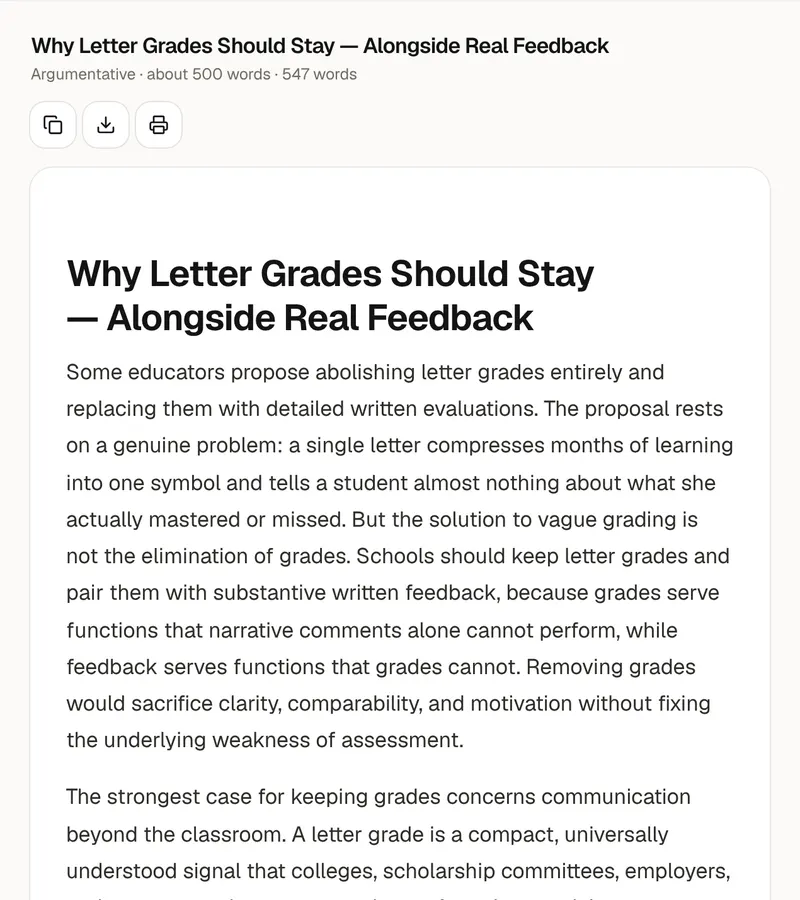
Choose the kind of thesis to match the assignment. An argumentative thesis takes a side and names its main reasons. An analytical thesis makes a claim about how or why something works, or what it means, not whether it is good or bad. An expository thesis states what the essay will explain and the aspects it covers, without taking a side. A compare and contrast thesis says what the comparison shows, not only that two things are similar and different. If you already hold a position, type it in and all four statements keep it. Then put the one you choose into your own words.
The tool knows only the topic and anything you type with it. It hasn't read your course material and it doesn't invent statistics, so the thesis is a starting point to check against your sources. Expect to revise it: a thesis often shifts once the essay is written, and the final version should match what you ended up arguing. “Outline this” sends a thesis to the essay outline generator, which plans the paragraphs around it. What you type is sent to the AI and isn't saved to an account or a database. In PocketNote, a course's lectures, PDFs and notes sit in one notebook, and you can chat across all of them to find the evidence your thesis needs.
FAQ
Questions, answered
Find the evidence for your thesis
PocketNote answers questions across every lecture, PDF and note in a course notebook.